

Key Takeaways
- Qualitative testing explains why users struggle, while quantitative testing measures usability performance.
- Use qualitative methods to discover problems through observation, interviews, and user feedback.
- Use quantitative testing to measure task completion, errors, efficiency, and improvements across different designs.
- Combining both methods helps identify problems, understand causes, and measure improvements.
- Choose testing methods based on research goals, participants, resources, and desired outcomes.
Imagine discovering that 70% of users abandon your signup process, yet having no clear idea why. Quantitative vs qualitative usability testing can help you connect that troubling number to the actual problems users face while navigating your product.
Quantitative testing identifies patterns using measurable data, including completion rates, errors, and task duration. Qualitative testing uncovers the reasoning behind those patterns through user comments, observed behavior, and follow-up questions. Together, they offer different perspectives on the same experience.
The real challenge is knowing which method fits your research goals. But don’t worry. This guide compares their strengths, limitations, and practical uses. You’ll learn how to choose the right approach and improve your product with confidence!
What Is Qualitative Usability Testing?
Qualitative usability testing helps you understand how users experience a product and why they face problems. It focuses on what users do, where they struggle, what they expect, and how they react while using a website or app.

For example, a UX researcher might watch someone book an appointment on a clinic's website. If the person hesitates over a button or says, "I thought this would show me the prices," the researcher learns where the design causes confusion.
These observations help the team understand usability problems and decide what to improve.
How Qualitative Usability Testing Works
Participants who match the product's target users complete common tasks, such as finding a product or signing up for an account. The researcher observes their actions, listens to their feedback, and asks questions when needed.

The researcher looks at four main things:
- Behavior: Where users click, hesitate, go back, or stop.
- Verbal feedback: What users say about the interface and what they expect.
- Reactions: Signs that users feel confused, frustrated, or satisfied.
- Motivations: Why users choose a particular action or path.
After several sessions, the researcher looks for common problems. For example, if four out of five participants misunderstand the same button label, the team has a clear reason to improve it.
Common Qualitative Usability Testing Methods
Researchers can use several methods to understand how users think, behave, and interact with a product. The most common qualitative usability testing methods include:
- Moderated usability testing: A researcher guides participants through tasks and asks questions to understand their actions.
- Think-aloud studies: Participants explain what they are thinking while using a website or app and help researchers understand their decisions.
- User interviews: Researchers talk to users before or after a task to learn about their expectations and experiences.
- Observation: Researchers watch users complete tasks without interrupting them and see their natural behavior.
- Open-ended feedback: Researchers ask questions like "What was the hardest part of this task?" to discover problems they might have missed.
What Is Quantitative Usability Testing?
Quantitative usability testing measures how well users interact with a website, app, or digital product using numbers. It focuses on how many users complete a task, how long they take, and how often they make mistakes.

This method is especially useful for comparing design versions. For example, if 61% of users complete a task with the old design and 78% succeed with the new one, the team can measure the improvement.
These results help identify problems, track progress, and make decisions based on data.
How Quantitative Usability Testing Works
Researchers ask participants to complete the same tasks under similar conditions. For example, users might need to find a premium plan's price and add it to their cart. Researchers record the results, such as task completion, time taken, and errors.
They then analyze the numbers to identify patterns and determine whether one design performs better than another.
Common Quantitative Usability Metrics
Quantitative usability testing relies on numerical data to evaluate user performance. Common metrics include:
- Task completion rate: The percentage of users who successfully finish a task.
- Success rate: Measures whether users complete a task fully, partially, or fail to complete it.
- Time on task: Measures how long users take to complete a task. Longer times may indicate usability problems.
- Error rate: Tracks how often users make mistakes while using a product.
- Task efficiency: Measures how much effort users need to complete a task, such as the number of steps they take.
- Satisfaction ratings: Measures how easy users feel a product is to use through ratings or surveys.
- System Usability Scale (SUS): A 10-question survey that produces a usability score from 0 to 100 and makes it easier to compare designs.
- Click and error patterns: Shows which screens, buttons, or steps cause the most problems.
Quantitative vs Qualitative Usability Testing: Key Differences
Although both quantitative and qualitative usability testing methods aim to improve the product, they differ in how they collect data, measure results, and identify problems.
Qualitative vs Quantitative Usability Testing Comparison
Here's a side-by-side comparison of their key differences:
Qualitative testing helps you discover usability problems and understand why they happen. Quantitative testing measures performance and helps you compare results. Neither method is better than the other. They simply serve different purposes.
What vs. Why: The Simplest Way to Understand the Difference
Quantitative testing shows what happened. Qualitative testing explains why it happened.
Imagine that 40% of users fail to complete checkout. Quantitative testing reveals the problem, but it doesn't explain the cause.
During qualitative testing, researchers notice that users struggle with the shipping options. One user asks whether standard delivery is free, while another selects the wrong option and has to go back.

These observations suggest that unclear shipping options may be causing users to abandon checkout.
The numbers show how serious the problem is. User observations help explain what's causing it and what the team should fix.
When Should You Use Qualitative Usability Testing?
Use qualitative testing when you need to find usability problems and understand why they happen. If your question starts with “why” or “how,” qualitative testing is usually a good choice.
Use Qualitative Testing to Find Problems
Qualitative testing helps you understand where users struggle and what needs to change. Use it when:
- Users cannot find a feature: Find out whether the label is unclear or the feature is hard to locate.
- Users misunderstand terms: Discover which words or instructions confuse them.
- Users abandon a task: Observe what goes wrong before they leave.
- Users hesitate at checkout: Find out what makes them unsure.
- Users struggle with onboarding: Identify unclear steps or instructions.
Qualitative Testing for Early Design
Qualitative testing works well with prototypes and redesigned interfaces. You can identify problems early, make changes, and test again without spending too much time or money.
When Should You Use Quantitative Usability Testing?
Use quantitative testing when you need to measure performance, compare designs, or track improvements over time. If your question starts with “how many,” “how fast,” or “did it improve,” quantitative testing is a good fit.
Use Quantitative Testing to Measure Performance
Quantitative testing helps you compare results against previous designs, competitors, or specific targets. For example, you can measure whether a new design improves task completion from 70% to 90%. These numbers show whether usability is improving.
Quantitative Testing for Product Decisions
Use quantitative testing when you need data to support a design decision. For example, if your team is choosing between two layouts, you can compare task completion rates and completion times.
You can also measure whether a redesign has improved usability by comparing results before and after the changes.
Qualitative vs Quantitative Usability Testing: Sample Size
The number of participants depends on what you want to learn. Qualitative testing usually needs fewer users to find problems, while quantitative testing needs more users to measure performance reliably.
How Many Users for Qualitative Usability Testing?
Qualitative usability testing often starts with around five participants. This can help researchers spot common usability problems, such as confusing buttons or unclear instructions. However, five users aren't always enough. If your product serves different user groups, you may need participants from each group to understand their needs.
How Many Users for Quantitative Usability Testing?
Quantitative usability testing usually needs a larger sample to produce reliable measurements and compare results. With too few participants, individual results can affect the overall findings.
Many quantitative studies use 30 or more participants, but the right number depends on how precise your results need to be and how much difference you want to measure.
Remember: Qualitative testing uses smaller samples to discover problems, while quantitative testing uses larger samples to measure performance. Choose your sample size based on your research goals, not a fixed number.
Advantages and Limitations of Qualitative Usability Testing
Qualitative usability testing helps teams understand user behavior and discover problems that numbers alone may miss. However, it also has some limitations to consider.
Advantages:
- Identifies usability problems that teams may overlook.
- Explains why users struggle and what causes confusion.
- Helps teams improve designs through repeated testing.
- Allows researchers to ask follow-up questions and explore user reactions.
- Requires fewer participants than most quantitative studies.
Limitations:
- Findings may not represent the experiences of all users.
- Reviewing observations and feedback can take time.
- Results may depend on how researchers interpret user behavior.
- Small samples cannot reliably show how common a problem is across the entire user population.
Advantages and Limitations of Quantitative Usability Testing
Quantitative usability testing helps teams measure user performance and track improvements using numerical data. It also makes it easier to compare designs and evaluate results. But just like qualitative usability testing, it also has limitations:
Advantages
- Measures usability through clear numerical data.
- Helps compare different designs and set performance benchmarks.
- Tracks usability improvements over time.
- Works with larger groups of participants.
- Shows whether design changes improve user performance.
Limitations
- Requires more participants and structured testing.
- Shows what went wrong but may not explain why.
- May require statistical knowledge to interpret results.
- Can take more time and money to plan and conduct.
Can You Combine Qualitative and Quantitative Usability Testing?
Yes, you can combine qualitative and quantitative usability testing. Combining both methods gives you a clearer picture of how users interact with your product.
Quantitative testing measures performance and highlights problems, while qualitative testing helps you understand why those problems happen. Together, they help you make better design decisions based on both data and user behavior.
You can also use ChatGPT for usability testing to support both testing methods and analyze user feedback. You can bring these two methods together at each stage of the design process, from finding usability problems to checking whether your solutions work.
The process starts with measuring user performance, then uses qualitative research to explore the causes. Here's how the design process go:
Measure → Identify → Observe → Fix → Retest → Compare
1. Measure: Record current performance using metrics such as task completion rates and error rates.
2. Identify: Find the tasks or screens where users struggle most.
3. Observe: Watch users complete those tasks to understand the reasons behind their difficulties.
4. Fix: Improve the interface based on your findings.
5. Retest: Ask users to complete the same tasks with the updated design.
6. Compare: Check whether the new results show better performance than before.
This approach helps you connect usability problems with their causes and check whether your solutions actually work. Quantitative data shows where improvement is needed, qualitative research explains what to change, and follow-up measurements help you evaluate the results.
If you need help turning these findings into a better user experience, Design Monks offers Usability testing services that help businesses improve digital products.
How to Choose Between Qualitative and Quantitative Usability Testing
The right method depends on what you want to learn. Use these guidelines to choose the best approach for your research.
Choose qualitative testing if:
- You want to find usability problems and understand their causes.
- You are testing an early design.
- You need detailed user feedback.
- You have a small or specialized user group.
Choose quantitative testing if:
- You need numerical data to measure performance.
- You want to compare designs or set benchmarks.
- You need to track usability over time.
- You want to measure results across a larger group.
Choose both methods if:
- You need to measure problems and understand their causes.
- Analytics reveal a problem, but you don't know why it happens.
- You want to check whether a redesign improved usability.
Quick tip: If you need to know what to fix, start with qualitative testing. If you need to measure performance, use quantitative testing. If you need both answers, combine them.
How to Run a Quantitative or Qualitative Usability Test
Whether you’re doing qualitative or quantitative testing, you need to go through a structured process for best results. Here's how you can run the tests:
Define Your Research Question
Start by deciding what you need to learn. For example, “Why are users leaving the signup form?” calls for qualitative testing, while “Did the new form improve completion rates?” calls for quantitative testing.
Recruit the Right Participants
Choose participants who match your target users. Qualitative testing usually needs a small group, while quantitative testing generally requires more participants to measure performance reliably.
Create the Tasks
Keep tasks clear and focused. Quantitative tests use the same tasks for everyone, while qualitative tests allow more flexibility to explore user behavior. For example:
- Quantitative: “Find the return policy and tell us how many days you have to return an item.” Every participant completes the same task under similar conditions.
- Qualitative: “Imagine you're planning a weekend trip. Show me how you'd start.” This lets researchers observe how users approach the task naturally.
Conduct the Test
Qualitative testing often uses moderated sessions, where researchers can ask follow-up questions. Quantitative testing may use moderated or unmoderated sessions, depending on the study's goals and the number of participants.
Analyze and Report the Results
For qualitative testing, group observations into common themes and identify the most serious problems.
For quantitative testing, calculate metrics such as completion rates and average task times, then compare the results against previous designs or benchmarks. Explain what the findings show without overstating the results.
Examples of Quantitative vs Qualitative Usability Testing
Here are three examples of how both methods help teams find and fix usability problems:
Example 1: Ecommerce Checkout
For an e-commerce checkout, quantitative testing measures how many users complete their purchases, how long checkout takes, and how often they make mistakes.
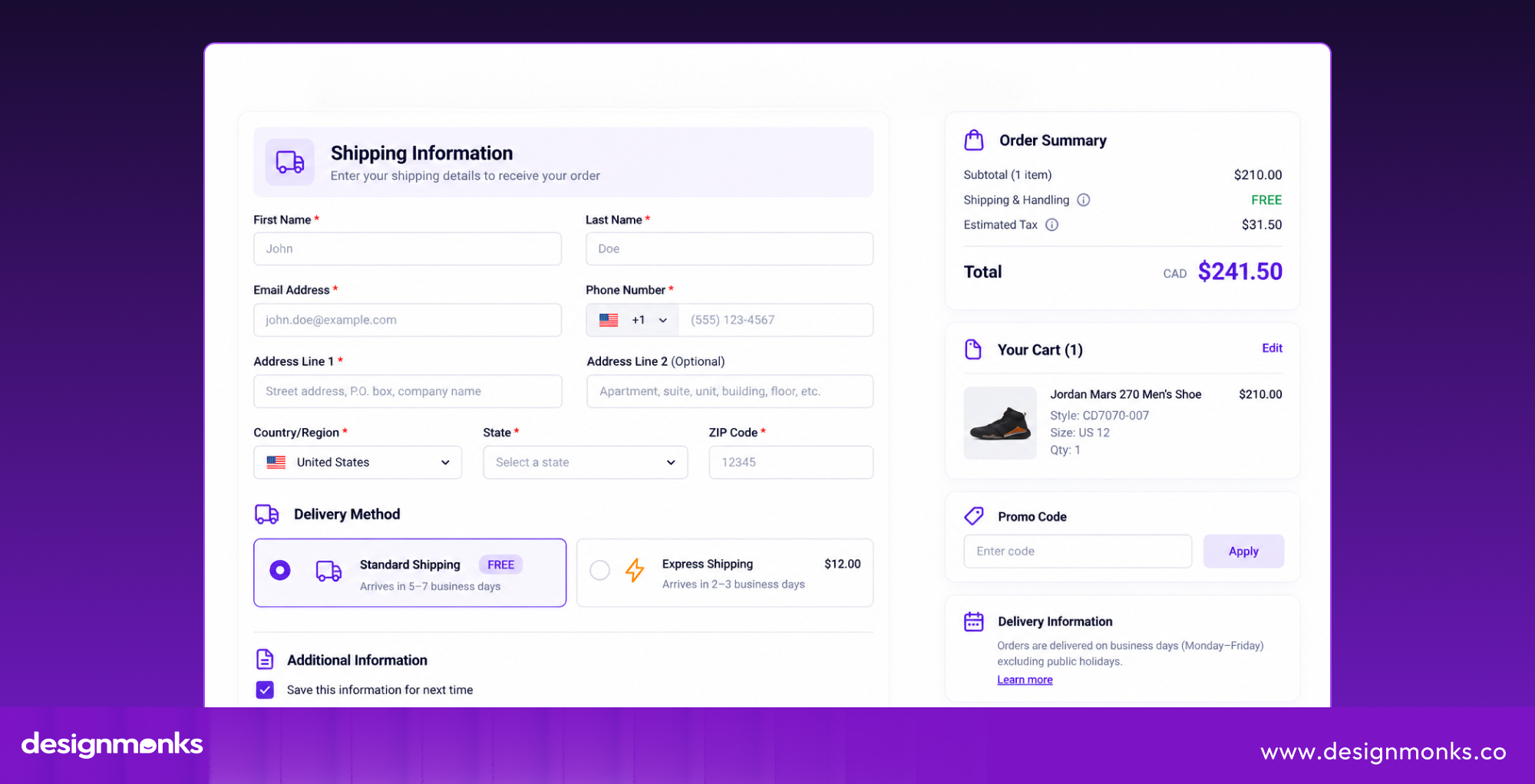
Qualitative testing helps researchers understand why users hesitate, misunderstand shipping details, or leave without buying. These tests help teams simplify checkout steps, clarify shipping costs, and reduce abandoned carts.
Example 2: SaaS Onboarding
For SaaS onboarding, quantitative testing measures how many users finish setup and how long they take. Qualitative testing reveals where users get confused and what they expect from each step.

For example, users might skip a required step because it looks optional. With both testing methods, you can find out why they did it and how many of them do it frequently.
Testing helps teams make instructions clearer, simplify setup, and help more users reach their first successful experience. And even if you’re redesigning your SaaS dashboard you can be sure to solve user pain points in first try.
Example 3: Mobile App Navigation
For mobile app navigation, quantitative testing measures whether users find the right screen, how long it takes, and how often they make mistakes. Qualitative testing helps researchers understand whether users find menu labels clear and can easily locate the features they need.

These insights help teams improve menu labels, organize features more clearly, and make important actions easier to find.
Common Mistakes in Quantitative and Qualitative Usability Testing
Both methods can produce misleading results if you don't use them correctly. Avoid these common mistakes:
- Using a small qualitative sample to represent all users.
- Collecting quantitative data without clear benchmarks.
- Changing questions during a quantitative study.
- Asking leading questions that influence users' answers.
- Recruiting participants who don't match your target audience.
- Tracking too many metrics instead of focusing on research goals.
- Assuming numerical results explain why problems happen.
- Ignoring user feedback when analyzing quantitative results.
You can also use the 10 usability heuristics for UI design to identify common interface problems and guide improvements.
Conclusion
Choosing between quantitative and qualitative usability testing comes down to what you want to learn.
Qualitative testing helps you understand why users struggle, while quantitative testing measures performance and tracks improvements. When you need both answers, combine the methods.
This approach helps you make informed design decisions. But if things get too much to handle, you can always contact Design Monks to help you out with any kind of usability testing!