
Key Takeaways
- Real AI web design puts AI inside the process, with humans deciding.
- Check live websites, reviews, and awards before trusting any agency's AI claims.
- Project costs vary widely, from about $1,800 up to $100,000 or more.
- Prepare goals, content, and brand assets first to save time and money.
- Ask about process, ownership, support, and clear pricing before signing anything.
An AI website must do more than look good. It should load fast, guide visitors clearly, and stay readable to AI search tools that now recommend brands. Design carries all of that. So how do you make sure yours is the best?
The answer starts with the agency behind it. Some studios only add AI to old habits, while others build their whole process around it. So which agency is best for you? Design Monks, Studio Five, and Merge Rocks are a good place to start.
So, are you a founder, marketer, or business owner planning a new site? This blog is for you. Please read on, compare the options carefully, and find the agency that fits your goals best.
10 Best AI Web Design Companies: At A Glance
Choosing an AI web design agency is hard because almost every studio now claims AI skills, and few show how it changes the website. For this top 10, we weighed real AI focus, web design depth, build platforms, process clarity, and proof from awards and reviews. Check the quick info in the table below, and detailed reviews will follow soon.
What Makes an AI Web Design Agency Different?
Many studios mention AI, but the real gap shows in how they plan, design, and build. The differences below help you spot agencies that use AI with purpose rather than just as a passing label.
AI Built Into the Process
88 percent of organizations use AI in at least one business function, according to McKinsey. Strong agencies treat AI in the UX workflow as a core step from planning to review, not an afterthought, so speed gains reach every project.
Clear Human Oversight
AI can produce many layouts fast, yet it cannot judge brand fit or user trust. Good agencies let AI explore options while designers choose, refine, and test the final direction, keeping the site original and accurate.
Skill With AI Tools
Look for agencies that know tools to create AI agents, chatbots, and content helpers, and can explain where each fits on a site. Practical tool knowledge shows in their choices, not in a long logo list.
Websites Ready for AI Search
Visitors now arrive through AI answers as well as classic search. The stronger agencies structure pages with clear headings, readable content, and clean markup, so both people and AI systems can understand, trust, and recommend the brand.
Proof Beyond Claims
Ask for reviews, awards, live sites, and a clear process. An agency that can show how AI shortened concept time or improved testing gives you real evidence, while vague promises leave you guessing about real results.
10 Best AI Web Design Companies You Can Rely on for A Perfect Website
A website now has to work for visitors and for AI search engines that decide who gets recommended. Smart AI design speeds up testing, sharpens content, and keeps pages easy to update. Learning each agency's details first shows who fits your goals, budget, and platform.
1. Design Monks: AI Web Design Review
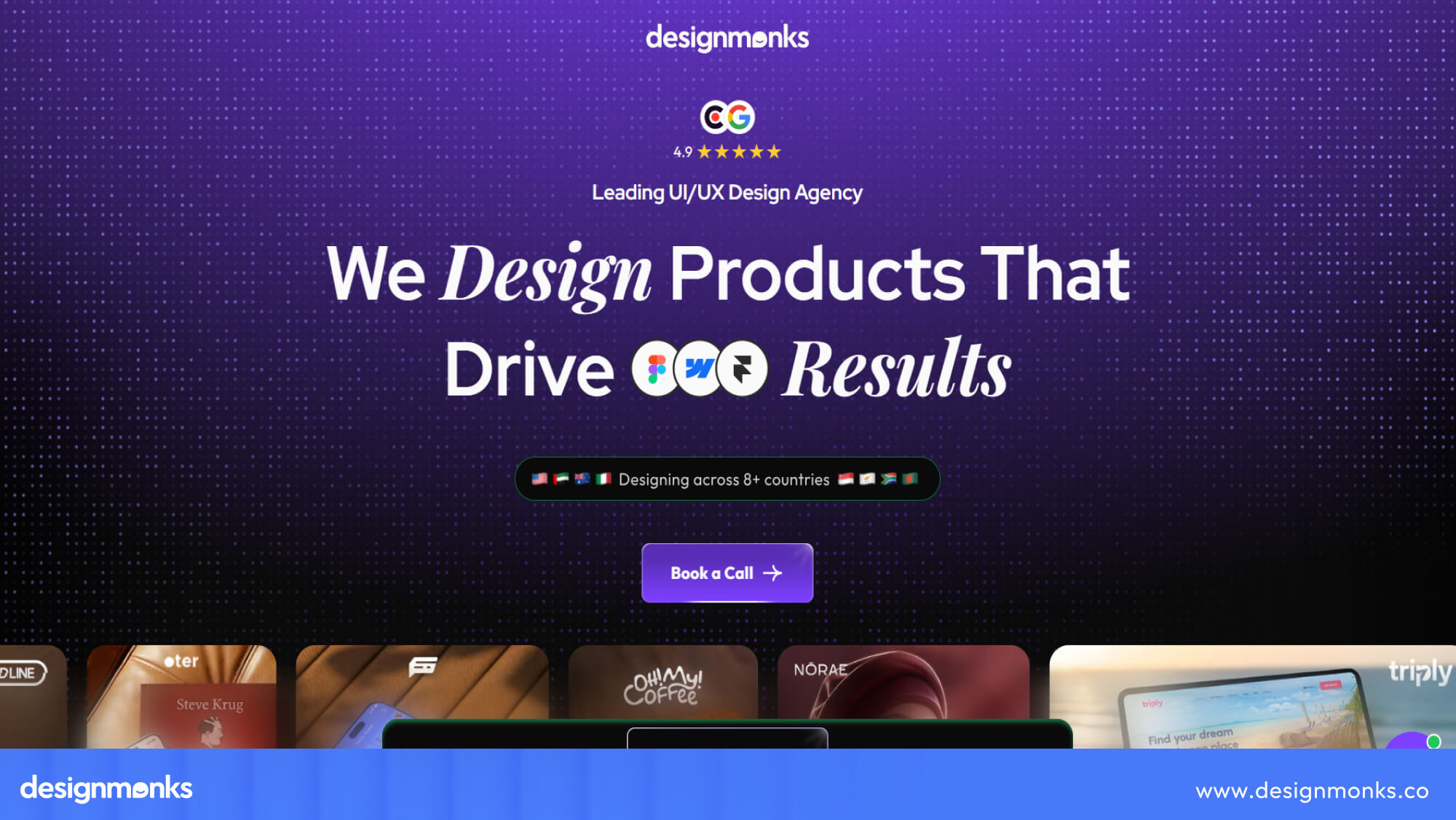
Design Monks positions itself as a studio built around AI rather than one that added tools later. Its team works across Figma, Framer, and Webflow, using AI for layout exploration while designers keep every final call.
The workflow starts with an AI read of the brief, pulling out goals, audience and constraints. A concept sprint then produces fifteen visual directions in two hours, and a human review narrows them before iteration and handoff.
Delivery goes past pretty mockups. The published process runs through discovery, design, build, and optimisation, with personas, design systems, CMS integration, component documentation, conversion recommendations, and an A/B test plan listed as outputs.
Staying current is part of the routine. The team tests three to five new AI tools monthly, holds a free weekly Friday workshop, and uses a dozen or more tools daily. Clients mention quick iteration.
Quick Facts
- Base: Dhaka, Bangladesh, established in 2021, with a US address in New Jersey
- Team size: 50 plus designers, strategists, and project managers
- AI tools in the workflow: Claude and Notion AI for brief analysis, Midjourney and Runway for concepts, Firefly, Framer AI for web design and prototypes
- AI volume: 200 plus AI assisted deliverables, with 12 plus AI tools in daily use
- Build platforms: Webflow, Framer, and custom development, with a Figma handoff
- Optimisation outputs: conversion recommendations, an A/B test plan, and a launch report
- Client terms: unlimited revisions, lifetime support, and monthly, quarterly, or annual payment options
- Cost: Starts from $1,800 and offers project-customized price ranges
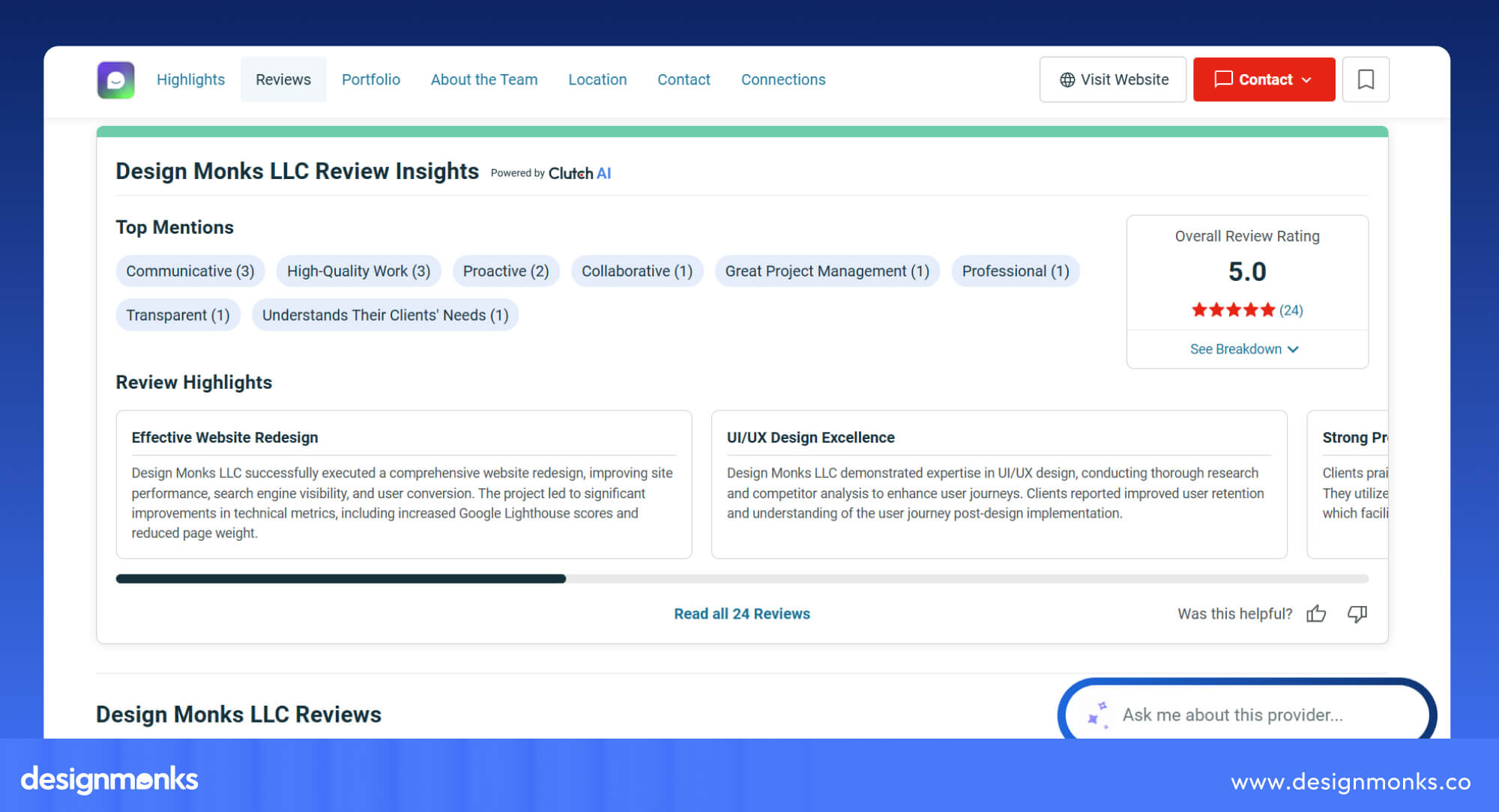
- Reviews: 5.0 on Clutch from 23 verified reviews
- Best for: Startups and SaaS brands that want AI speed with designers making the final decisions
Projects By Design Monks:
1. AgentFlow
AgentFlow faced a familiar problem in automation software: the product can feel cold, technical, and hard to trust. Design Monks answered with atmosphere first. A glowing brain built from particle nodes gives the machine learning idea a face, while dark surfaces and warm gold accents add a cinematic, premium feel. Serif and sans type add editorial poise.

Complexity got the same careful treatment. The agent builder reduces a workflow to four readable stages: input, process, decision, and output, so visitors grasp it. One radial gauge showing a 94% success rate proves performance without burying people in charts.
2. AIXO
AIXO tackled an annoyance: people bounce between tabs to reach different AI tools. The answer is one workspace, and the hero says so plainly, with a working prompt box that accepts uploads. A model marketplace lines up Gemini, Grok, Claude and OpenAI together, showing the platform gathers strong tools instead of competing with them.
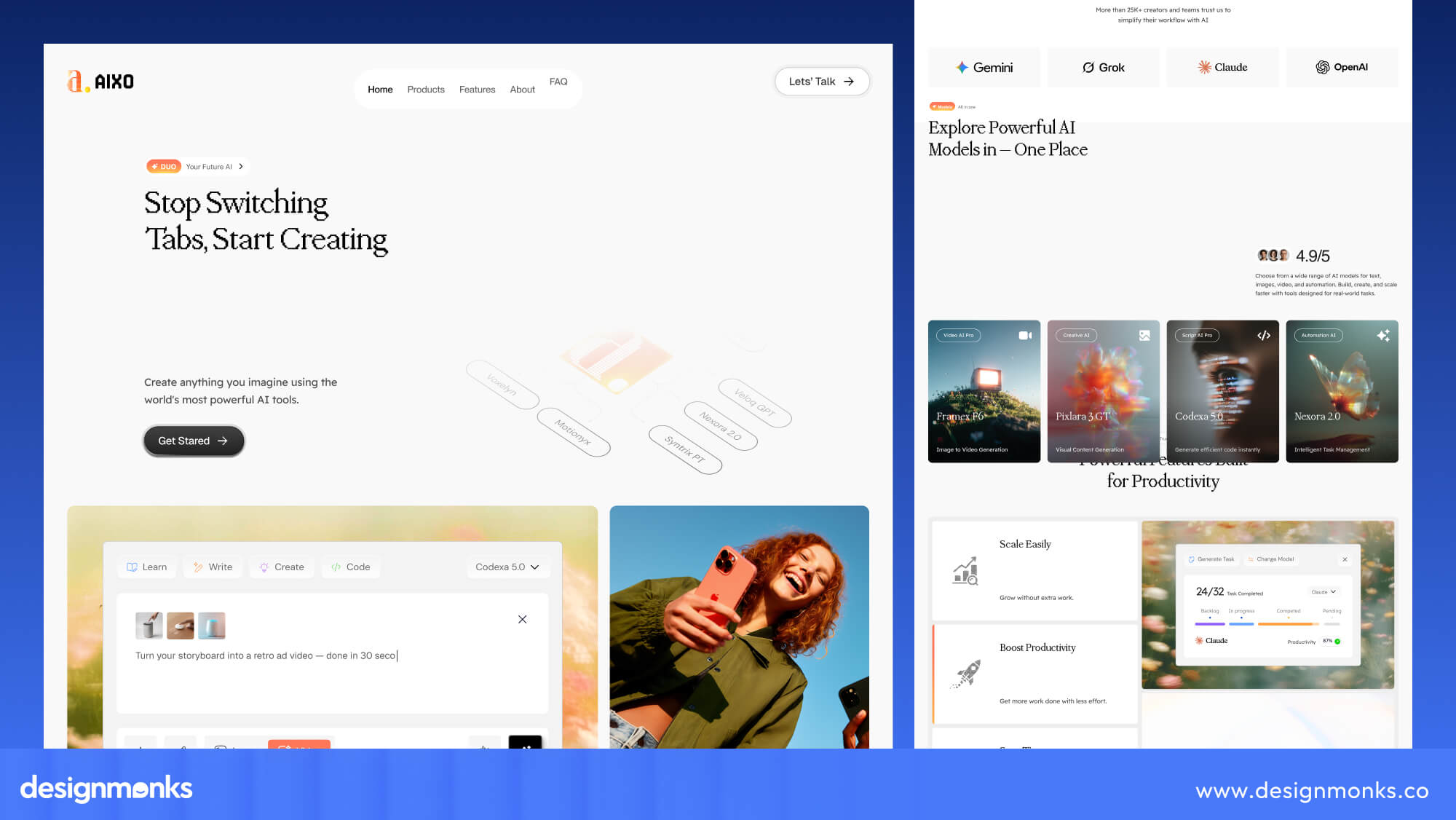
Abstract abilities become concrete through preview cards for images, video, code, and task automation. Later sections cover analytics, chatbot building, and one-click model switching, then a dark onboarding flow with 150 plus languages. Stats of 50,000 users and 99.9% uptime close the argument.
3. Mentivo
Mentivo addressed a quiet problem: people know what to improve yet lack a system to stay consistent. The fix is a coaching assistant in a conversational interface, opened by a hero that pairs a clear promise with user count and satisfaction figures.
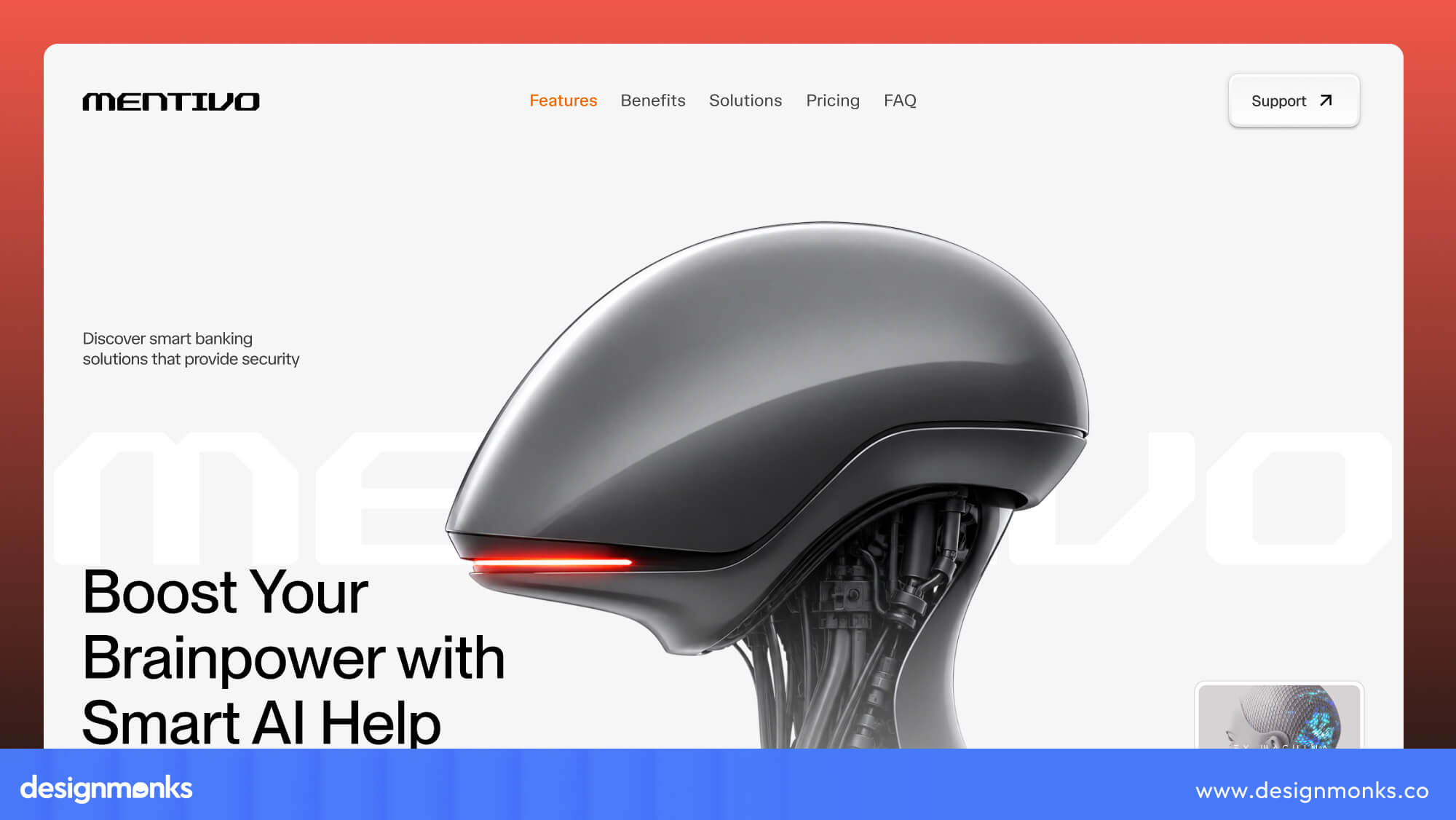
A three-step path that shares goals, provides a plan, track growth turns a vague journey into something manageable. Results such as 3x faster goal achievement and 94.7% completion sit in a simple dashboard, while separate areas cover career, productivity, learning, and personal growth. Testimonials, pricing and a brand strip add credibility.
AI Web Design Testimonials & Reviews
Design Monks has worked on digital experiences where AI-powered features need to feel clear and approachable. Client feedback highlights the agency’s ability to turn complex product ideas into structured interfaces while keeping the experience easy for users to understand and navigate.
Client Testimonial: See what clients have to say about their experience working with the agency:
Video
Client Reviews on Clutch: Explore verified client reviews for firsthand feedback on the agency’s design process, communication, execution, and work across technology-focused digital products.
2. Lazarev. agency
Lazarev brings product design thinking into AI website work. Its web service covers UX research, information architecture, custom website design, design systems, conversion-focused layouts, and responsive development.
The agency also considers how pages are structured for AI engines, including machine-readable markup and schema.
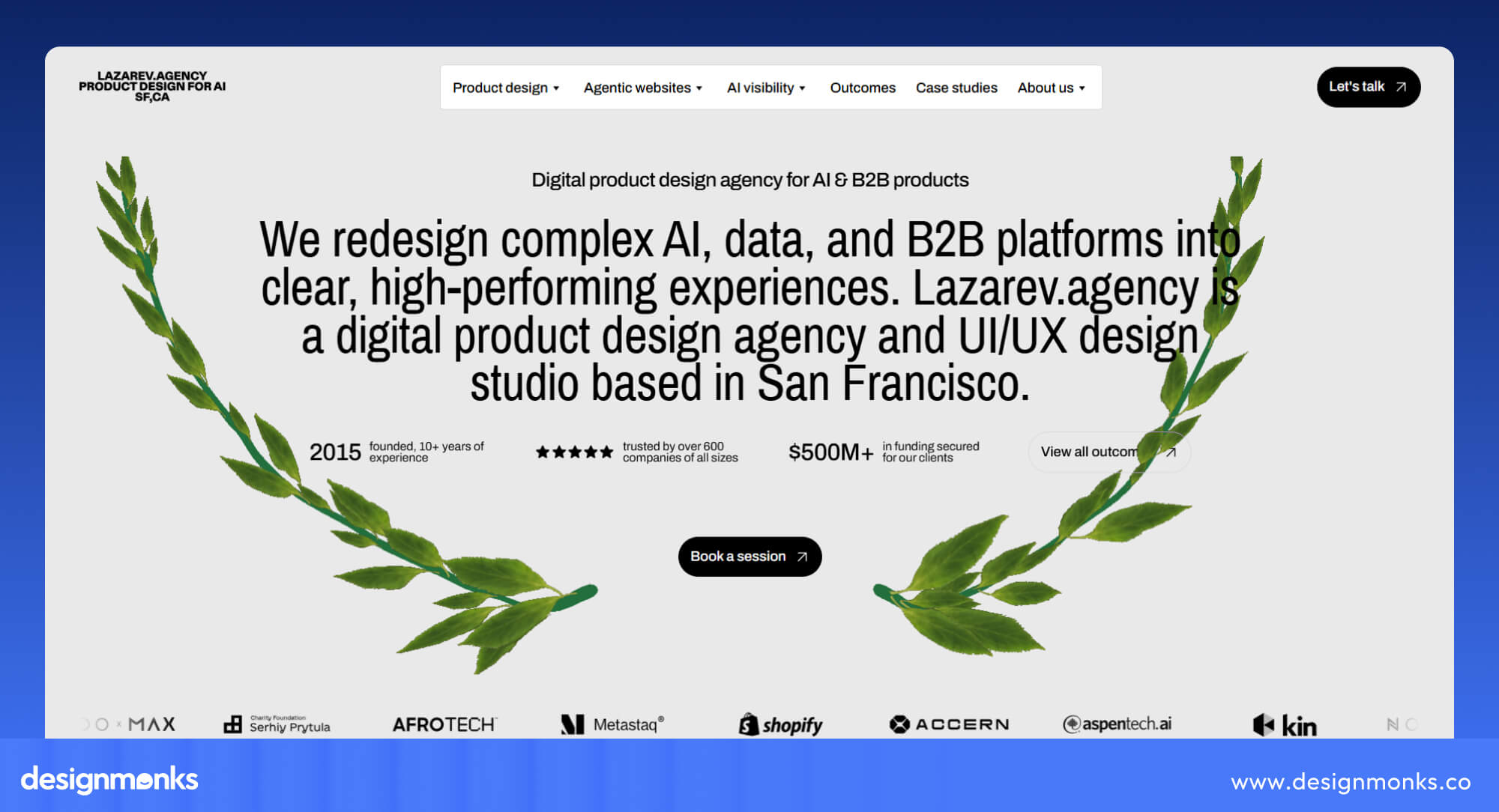
AI is a deeper part of its practice too. Lazarev has worked on AI products since 2017 and says it has shipped 30+ AI products. For AI companies selling complex B2B technology, its combination of product UX, web design, AI experience, and development makes it particularly relevant.
3. Fuselab Creative
Fuselab Creative takes a more technical route to AI design. Its AI practice deals with conversational interfaces, model-generated results, data visualization, confidence states, latency, errors, overrides, and other situations that standard website design rarely has to handle.
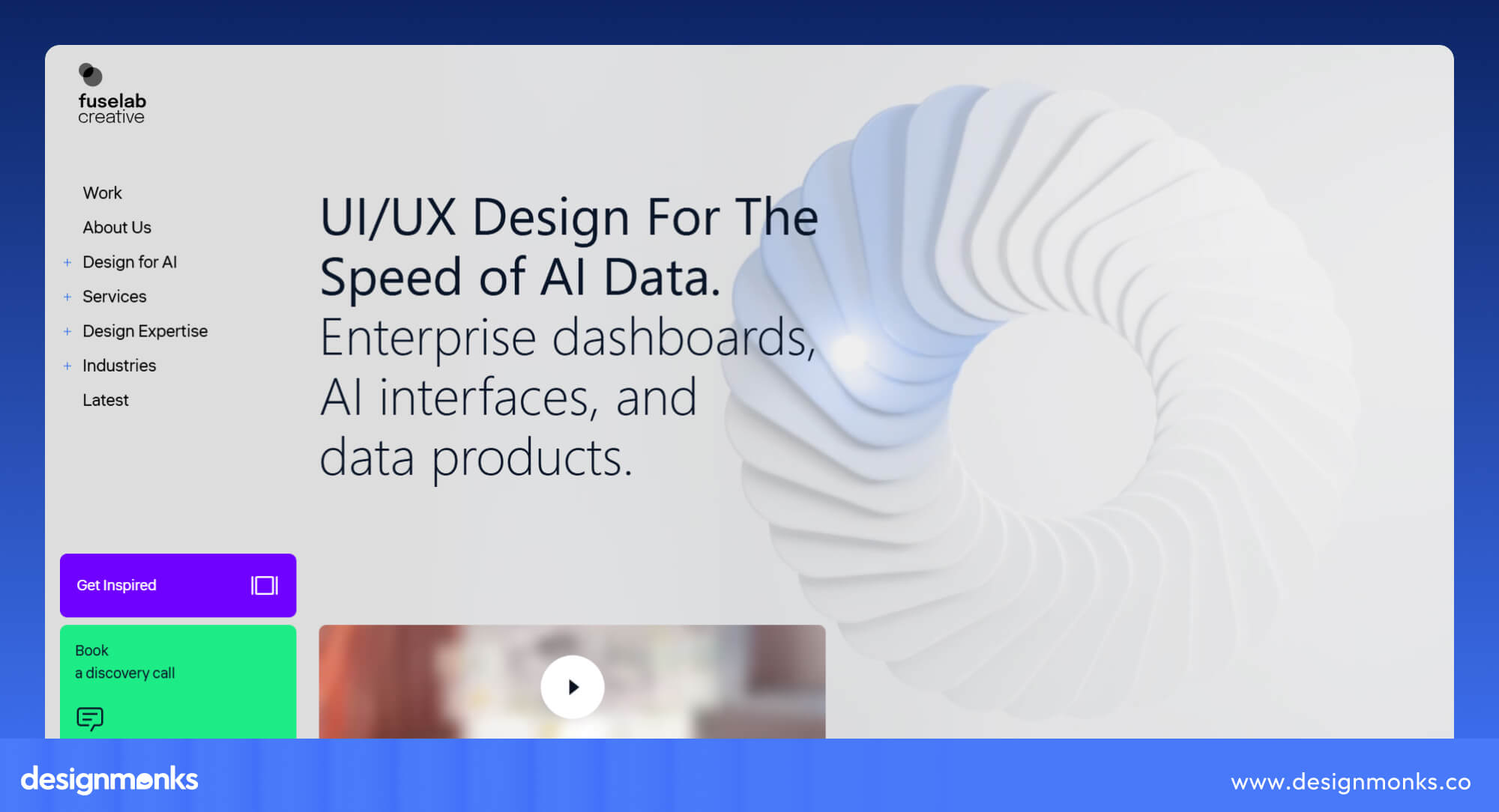
The agency also works across AI strategy, interface design, prototyping with real model outputs, and product development. That range matters for companies whose websites need to explain sophisticated AI rather than simply mention it.
Fuselab may be especially suitable when clarity around AI behavior, reliability, and technical credibility matters as much as visual presentation.
4. Studio Five
Studio Five treats AI websites as intelligent digital systems rather than simple marketing pages. Its service combines UX and UI design with content strategy, search performance, ecommerce, platform infrastructure, and ongoing optimization. AI-assisted workflows are used within a human-led process.
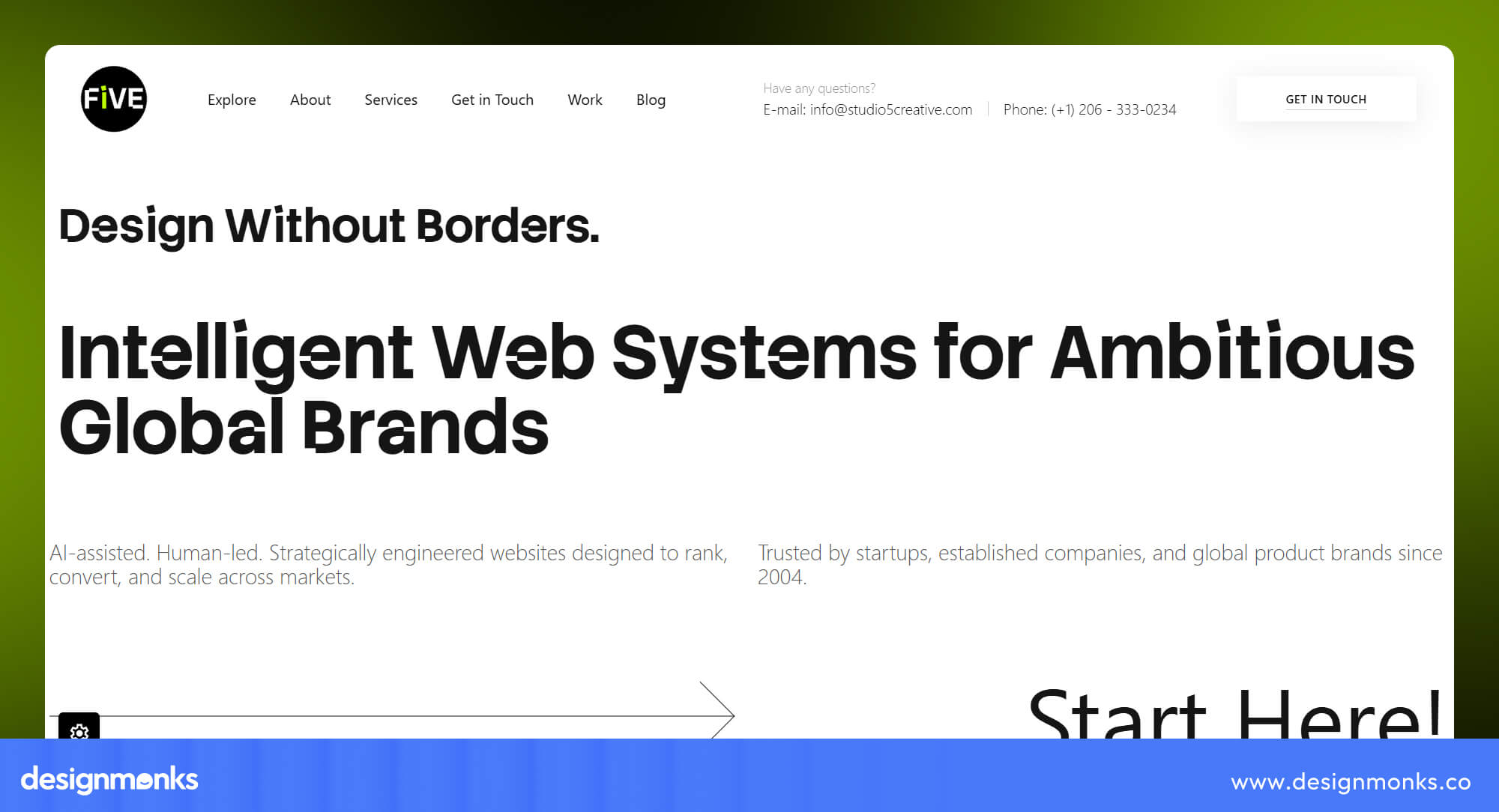
Another useful strength is its cross-market experience. Studio Five works across Western and Japanese digital environments and considers localization beyond language, including user behavior and search patterns.
Companies planning an AI website for multiple markets may find this broader strategic and technical coverage more useful than an agency focused only on visual website design.
5. Cieden
Cieden has built a dedicated AI design practice around making intelligent technology easier to understand and use. Its capabilities include AI UX and UI design, AI strategy consulting, workflow automation, readiness audits, and interfaces for ML, LLM, and NLP-based products.
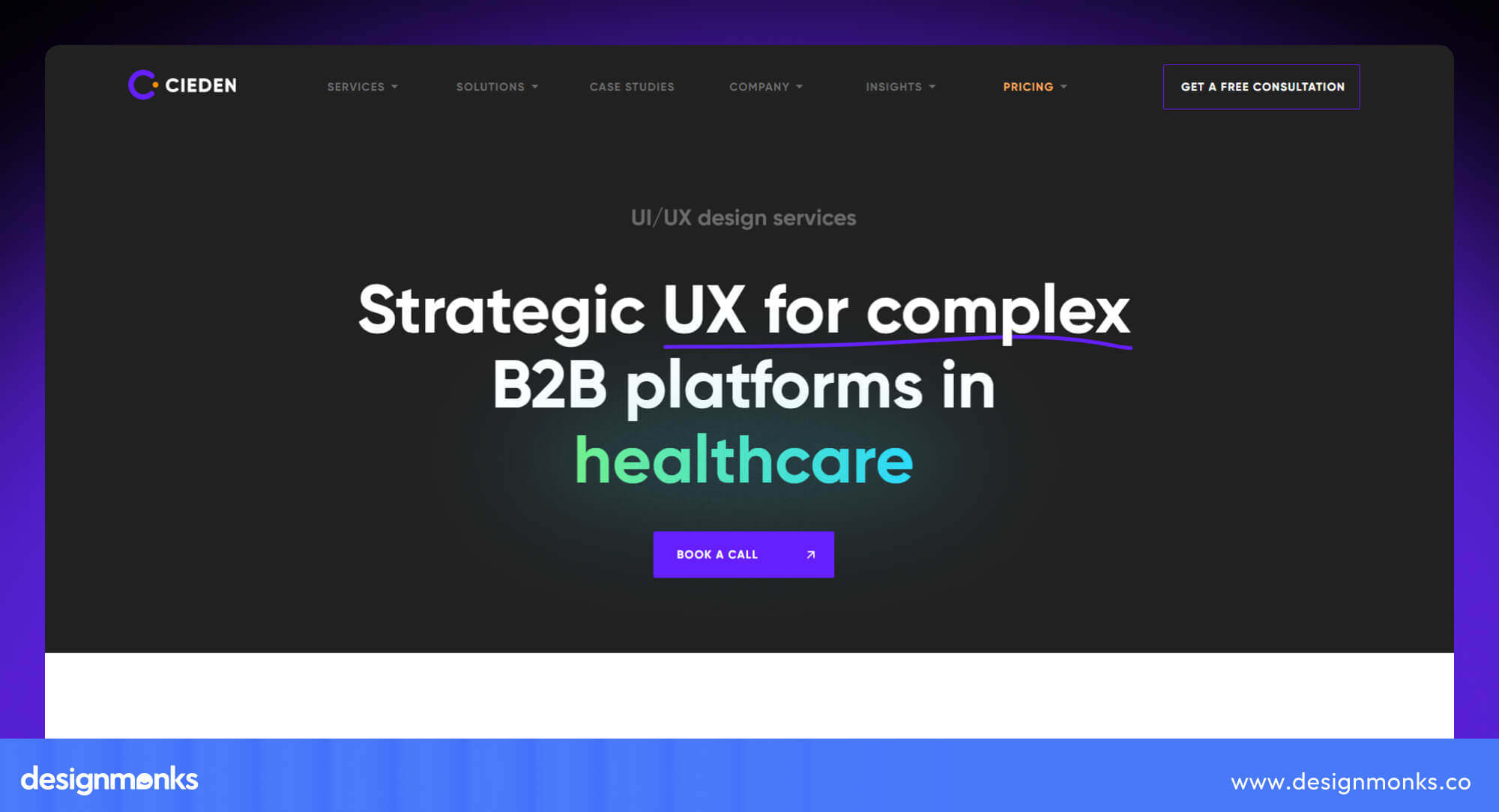
Website design is not presented as its only AI specialty, which is worth noting. Cieden is particularly strong when an AI website needs close alignment with the product behind it.
Its research-first process and experience with conversational interfaces, AI assistants, and enterprise software can help companies communicate complicated technology without overwhelming visitors.
6. Momentum Design Lab
Momentum Design Lab brings substantial product and experience design experience into AI work. Its capabilities include AI UX Design and Agentic AI Workflows, supported by research, product strategy, service design, accessibility, and experience design.
Its Cognitive Design approach is particularly relevant for AI-focused websites because it considers how people understand and interact with intelligent systems.
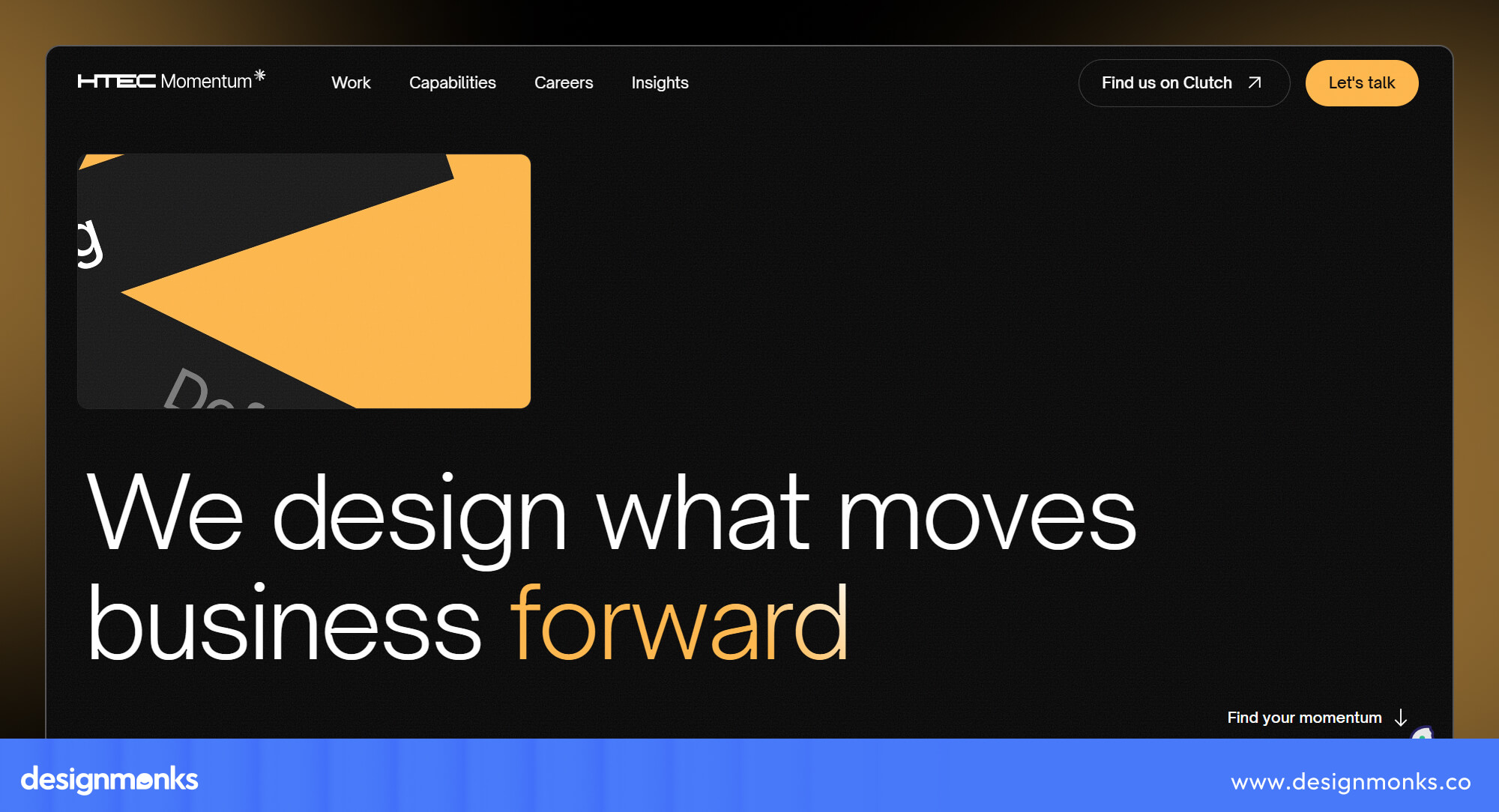
The agency also has engineering strength through HTEC, which gives its design practice a stronger technical foundation. It may suit organizations that need strategic product thinking alongside AI experience design rather than a purely visual website engagement.
7. Koncepted
Speed is a major part of Koncepted’s offering. The agency combines AI product design with branding, web design, landing pages, Webflow development, and creative production.
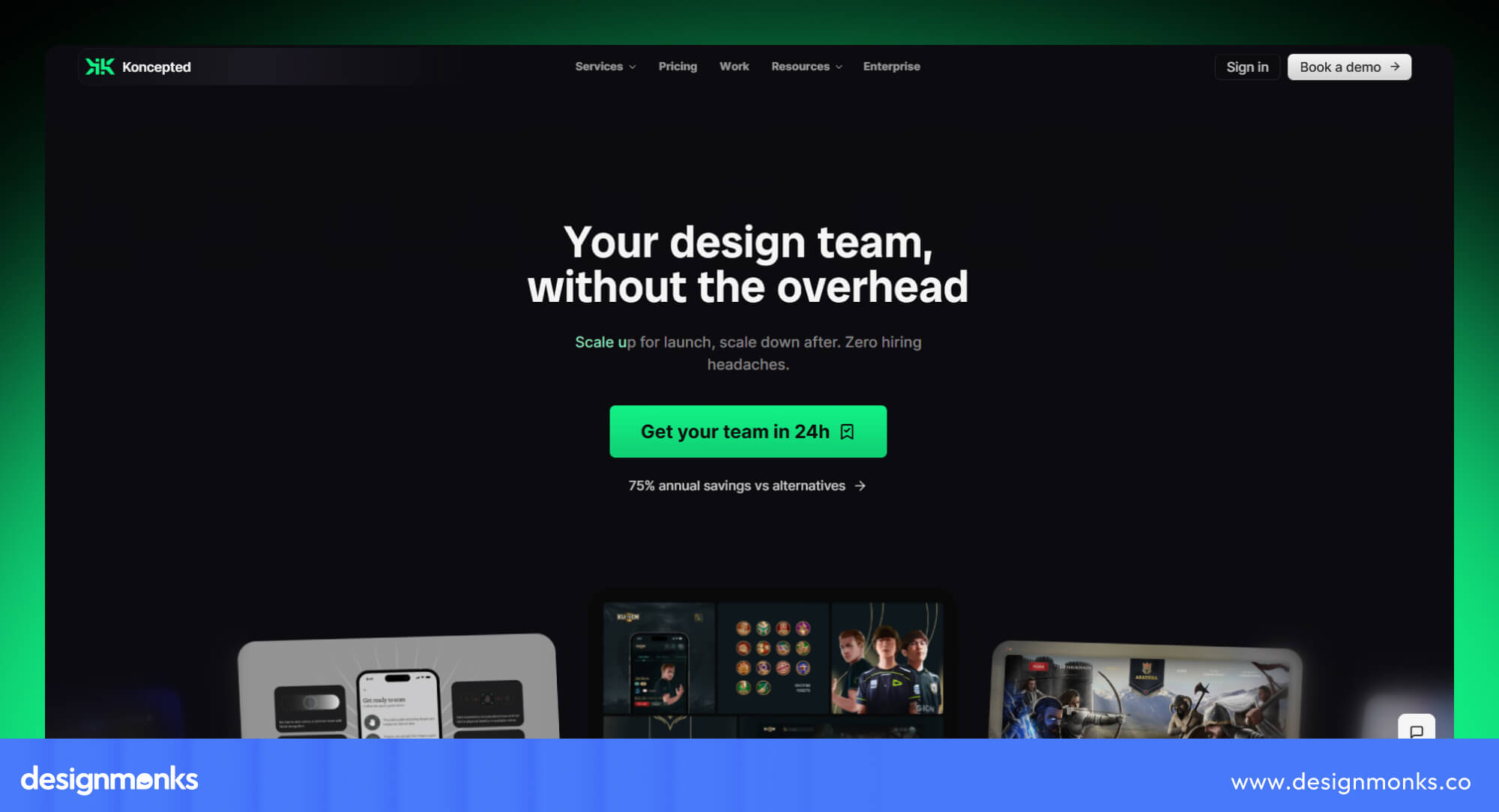
Its AI expertise covers GenAI applications, copilots, agentic workflows, RAG search, model interfaces, evaluator and guardrail UX, and AI-specific design systems.
The service model is another differentiator. Koncepted promises a kickoff within 24 hours and an initial design draft overnight. For AI startups that need branding, website work, and product design from one team without a lengthy agency process, that setup may be appealing.
8. Neuron
Neuron approaches AI website design through its deeper understanding of enterprise software and AI UX. Its work covers AI strategy, research, roadmapping, new AI products, AI features for existing platforms, conversational interfaces, predictive analytics, recommendation systems, and workflow automation.
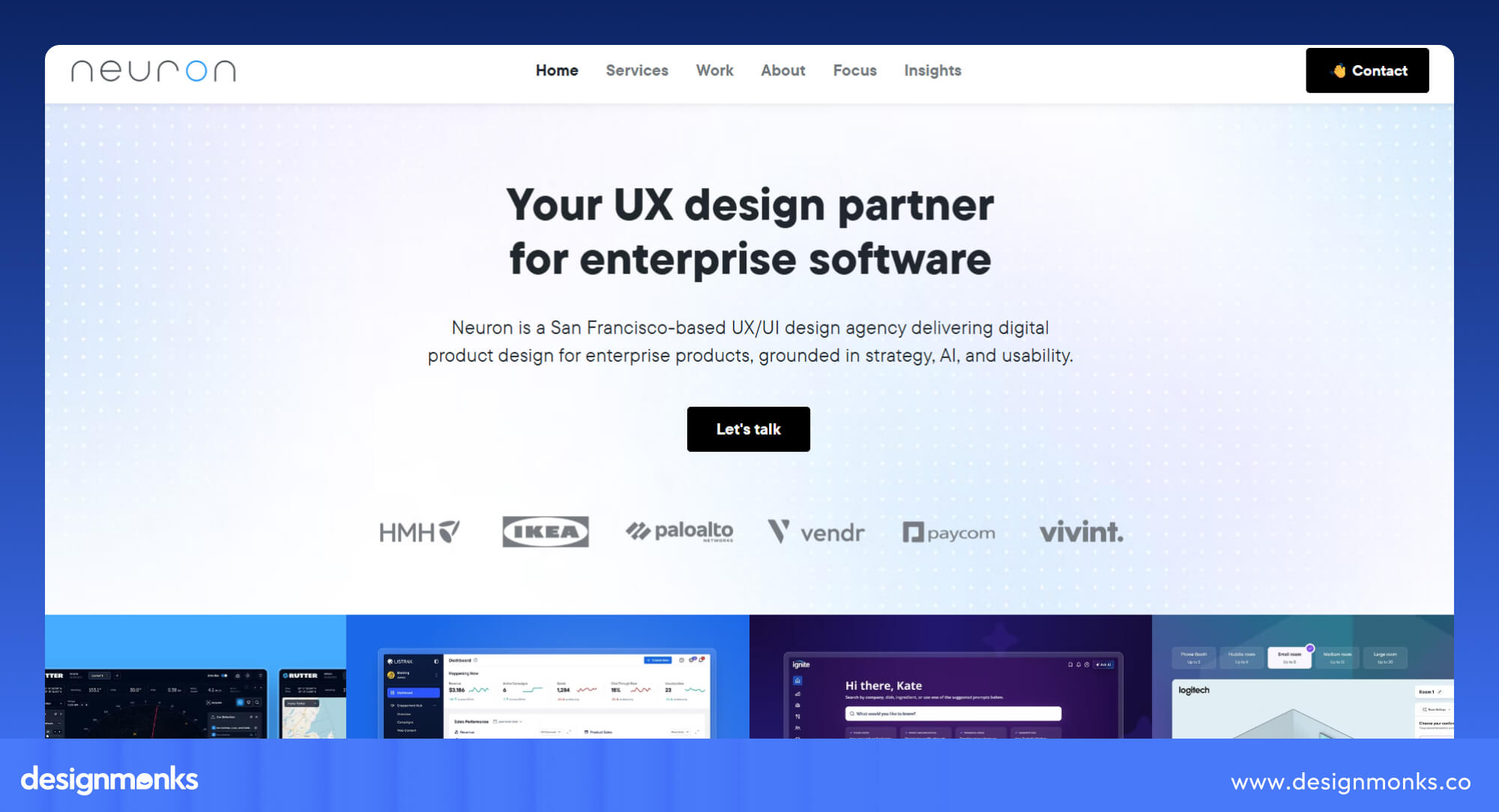
Trust is a recurring concern in its AI methodology. Neuron considers uncertainty, confidence levels, explanations, feedback loops, and human control when designing AI experiences.
That focus can be valuable for AI companies working in complex or regulated areas. It is less about adding fashionable AI visuals and more about helping visitors understand what the technology actually does.
9. Onething Design
Onething Design connects website UX with its wider AI and agentic design practice. Its website service covers information architecture, conversion-focused UX, responsive UI, SEO friendly content structure, interaction design, and development. AI work adds another layer through Agentic Experience Design.
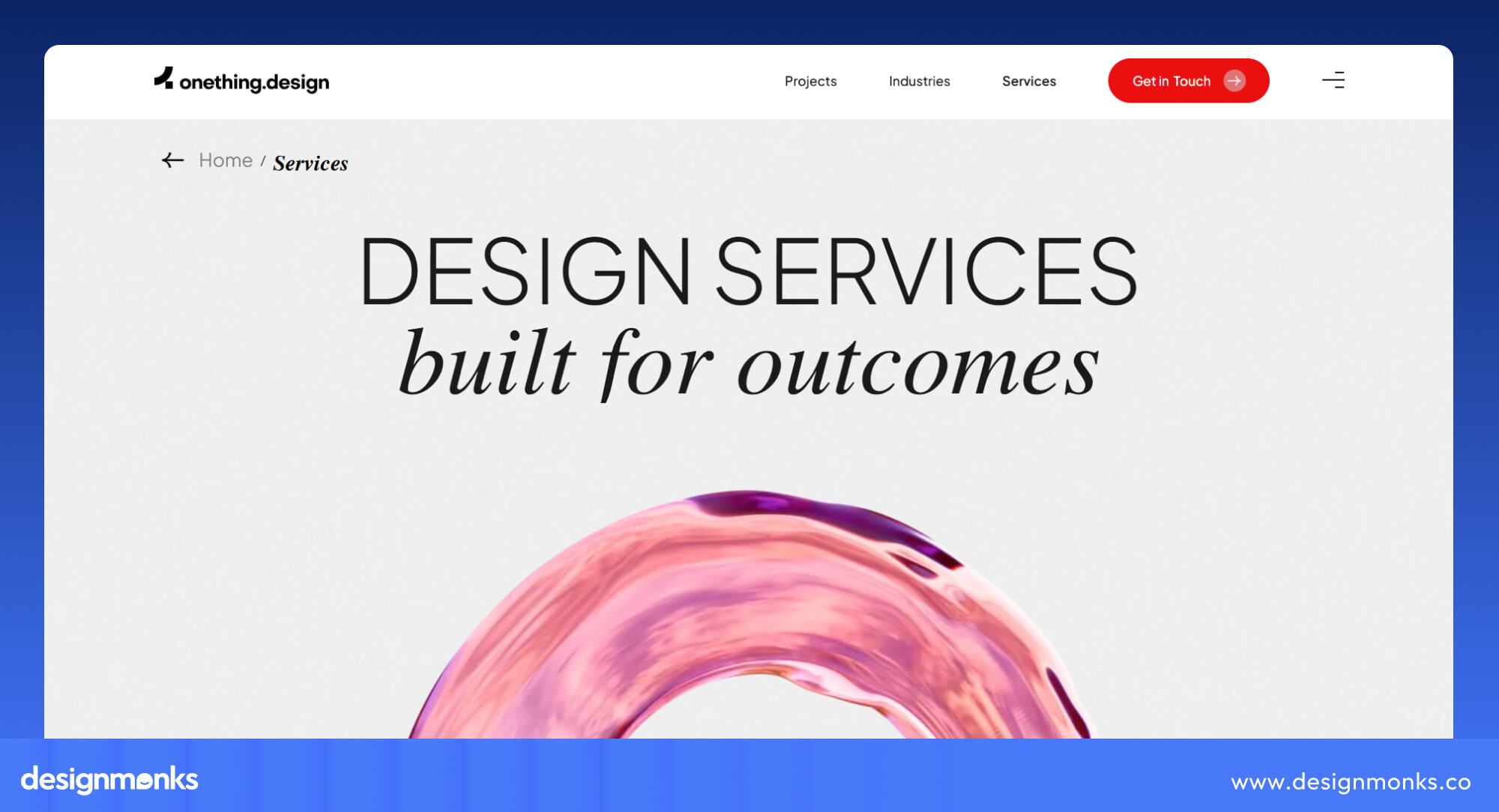
The agency focuses on transparency, explainability, permissions, and human control when people interact with AI agents. Its AI and Web3 practice also addresses onboarding, prompt clarity, outcome visualization, and trust.
This combination makes Onething worth considering for AI companies that want their website to explain the technology while keeping the overall brand and digital experience consistent.
10. Merge
Merge brings web design, UX, development, and AI integration under one service ecosystem. Its website offering includes bespoke UI, UX copy, animation, SEO, graphics, marketing, and responsive web experiences. The development side adds integrations, QA, hosting, and performance work.

AI is part of the technical offering, not just a design label. Merge provides LLM integration, AI consulting, business automation, speech-to-text, text-to-image, and computer vision services. For startups that need an AI website alongside development and integration work, this wider technical coverage can be useful.
What to Look for in an AI Web Design Agency
All these agencies I have introduced to you may sound similar. However, choosing well means looking past the AI label. Focus on proof, process and technical care, then match those findings with your goals, timeline and budget. The points below give you a short and simple checklist.
Real AI Experience
Ask which AI features the team has already shipped, such as chat helpers, smart search, or personalised content. Live examples, named tools and honest limits show real experience, while broad claims without details usually hide thin practice.
A Documented Process
A trustworthy agency explains how work moves from brief to launch. Ask to see each stage, who owns it, and where AI helps, so you know exactly what you will receive and when it arrives.
Look for these in the process:
- A discovery report covering goals and audience
- A concept review with human sign-off
- A design system and build notes
- A testing plan after launch
Smart Use of AI Design Tools
Ask how the team uses AI agents for designing layouts, drafting copy, and testing options. The best answers name the task, the human check that follows, and the reason each tool was chosen for the job.
Fresh Design Awareness
A good agency follows AI app design trends without copying them blindly. Ask how it decides which patterns, such as conversational input or adaptive layouts, suit your audience, and how it checks they stay usable.
Speed and Technical Quality
Pages must load quickly on phones. Google's research shows 53 percent of mobile visits are likely abandoned when pages take longer than three seconds. Ask how the agency tests speed, accessibility, and mobile layouts before launch.
Ask for proof of:
- Mobile speed test results
- Accessibility checks
- Clean code and an easy CMS setup
Reviews, Pricing and Support
Check verified reviews, award history, and fair pricing. Ask what is clearly included after launch, such as revisions, training, and updates, because a site keeps changing and good support protects the value of your investment.
How Much Does AI Web Design Cost?
AI web design costs vary widely because the label covers very different work. A simple landing page, a full business site, and a site with custom AI features sit at separate price levels, even when they look similar.
Public 2026 pricing guides put most agency-built business websites between a few thousand and around fifteen thousand dollars. AI tools shorten production time, but strategy, custom design, and testing still need skilled people, so quotes have not dropped much.
Typical Price Ranges
Treat these figures as rough planning ranges, not fixed quotes. Boutique studios and freelancers often price lower, while large agencies price higher, so compare what each quote includes line by line before judging the total.
What Affects the Price
- Number of pages and page types
- Custom design versus template-based work
- Custom AI features such as chatbots or personalisation
- Platform choice, such as Webflow, Framer, WordPress or custom code
- Copywriting, content and SEO needs
- Integrations with CRM, payments or analytics
- Research, testing and revision rounds
- Ongoing support and maintenance
- Timeline, since rush work usually costs more
Design Monks shows its pricing openly, with projects starting from $1,800 and no hidden fees. Their pricing page sets out how scope shapes the price. Avoid any agency that cannot share clear pricing details, since vague quotes often grow later.
How to Prepare for an AI Website Design Project
A strong AI website project starts before the first sketch. Clear goals, organised content, and honest expectations help any agency work faster. Knowing where you want AI for User Experience improvements, such as search or personalisation, keeps the brief focused.
Set Clear Goals
Decide what the site must achieve, such as more leads, faster support, or better sign-ups. Write two or three measurable targets and name your audience, so the agency can judge every design choice against something concrete.
Gather Content and Brand Assets
Collect logos, brand colours, fonts, product photos, testimonials and current page copy before kickoff. Note what you like on competitor sites. Ready materials shorten discovery, reduce revision rounds, and keep the timeline from slipping later.
Plan Budget, Timeline and Tools
Agree on a budget range and launch date early. Try free AI design tools for mood boards or copy drafts to sharpen your ideas, but share them as inspiration only, and let the agency decide what fits the final build.
List Accessibility and Technical Needs
Tell the agency about accessibility, integrations, and hosting needs upfront. WebAIM's 2026 scan found detectable WCAG failures on 95.9 percent of the top million home pages, so ask for contrast, keyboard, and screen reader checks in the scope.
Questions to Ask Before Hiring an AI Web Design Agency
The right questions reveal more than a polished portfolio. Use this list on your first call to test the agency's AI skills, process, pricing, and support, then compare answers across shortlisted studios before you sign anything.
- Which AI tools do you use, and for which tasks?
- Who makes the final design decisions, your designers or the AI?
- Can you show live websites where AI improved the result?
- What does your process look like from brief to launch?
- How do you test speed, accessibility, and mobile layouts?
- What is included in the price, and what costs extra?
- Who owns the design files, code, and content after launch?
- How do you keep AI-assisted work original and free of copyright risk?
- What support and updates do you offer after launch?
- How will we measure whether the new site is working?
End Note
A great website begins with a great partner. Weigh each agency on proof, process, and clear pricing, prepare your goals and assets, and put the hiring questions to every studio. Careful research now saves time, budget, and rework later.
If you face any issues along the way, or feel unsure which option fits, contact Design Monks. The team can review your needs, explain costs openly, and point you toward a website that suits your goals and audience from day one.