.svg)




Key Takeaways
- Market research identifies demand, competition, and business opportunities.
- User research uncovers user needs, behaviors, and pain points.
- Market research focuses on markets, user research focuses on people.
- Both research types help teams make smarter product decisions.
- Combining both creates products aligned with users and markets.
Market research vs user research can be the difference between building something people say they want and something they actually use. Imagine launching a product with strong demand and early interest, only to watch users disappear. So, what went wrong?
The problem is simple, the team understood the market, but not the people in it. Market research can reveal demand, trends, and competitors, while user research uncovers real needs, behaviors, and frustrations.
Looking at only one side leaves a gap, and that can lead to expensive mistakes. Knowing which research to use and when can make the difference between a product that succeeds and one that falls short. Let’s look at where the two differ and why it matters.
Market Research vs User Research at a Glance
Market research helps you understand what is happening in the market and where an opportunity may exist. User research helps you understand what people need and how they experience a product.
Before getting into the details, here’s the simplest way to separate market research from user research:
Market research feeds the boardroom, user research feeds the design table. Neither one replaces the other, and honestly, the best product teams treat them like two eyes, you need both for depth perception.
Use only market research, and you'll build the right idea, badly. Use only user research, and you might build something beautifully usable that nobody actually wants.
What Is Market Research?
Market research is the process of learning about a market before making an important business or product decision.
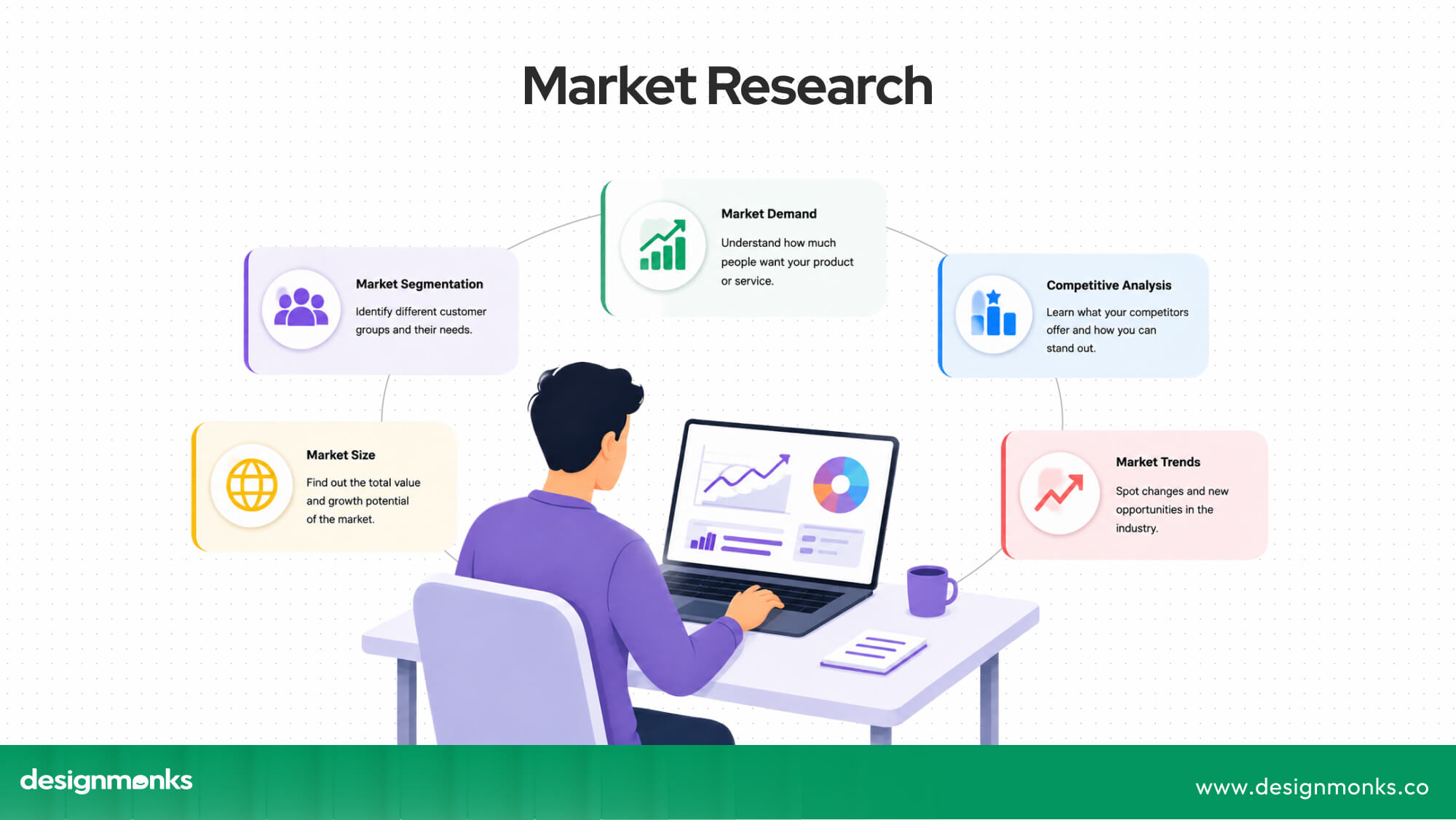
Instead of guessing what people want, businesses look at things like market demand, customers, competitors, trends, and opportunities to get a clearer picture of what is actually happening. It helps to answer practical questions such as:
- Do people need this product?
- How big is the market?
- Who are the competitors?
- What are they doing well?
- What are customers looking for?
- Is there a gap that a new product could fill?
For example, before launching a fitness app, a company might research similar apps, their pricing, customer reviews, popular features, and current market trends. This gives the team a better idea of what could work and where there may be room to do things differently.
That is what makes market research so important. It gives businesses useful information to work with instead of relying on assumptions or gut feelings.
Without proper market research, businesses can easily make costly assumptions. They might target the wrong audience, enter an already crowded market, price the product poorly, or build something people simply don't need.
Overall, market research helps you understand the market, find the right opportunity, and make a more informed decision about what to do next.
What Is User Research?
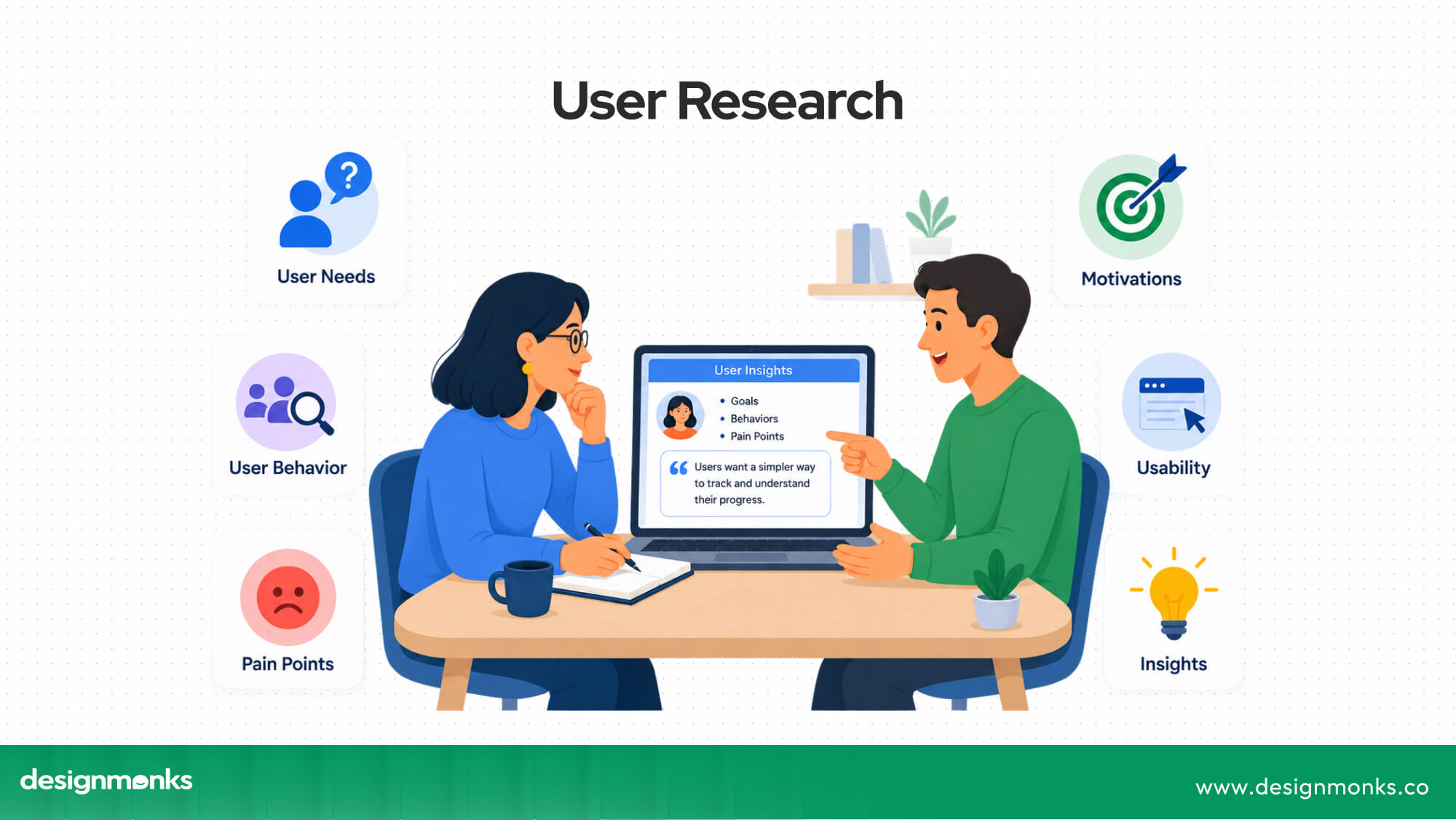
User research helps product teams understand the people they are designing for. It looks at what users need, what they are trying to achieve, how they behave, and where they run into trouble while using a product.
Researchers can interview users, watch them complete tasks, test prototypes, or look for patterns in how they use a product. These activities can uncover things teams may not notice on their own, such as:
- Why are users leaving at a certain point?
- What is making a task harder than it should be?
- What are users actually trying to accomplish?
- Which problems come up again and again?
- What do users expect the product to do?
- What could make the experience easier?
These findings give teams clear problems to solve. They can remove unnecessary steps, improve confusing features, and focus their effort where it will have the most impact.
For example, a food delivery app may see that customers are abandoning checkout. Talking to users could reveal that the delivery fee appears too late or that the address form is confusing.
This kind of early investigation is where formative UX research can help and give teams a clearer understanding of user problems before they refine the solution.
Without user research, teams can end up designing around assumptions and internal opinions. They may polish features users barely care about while overlooking simple frustrations that stop people from completing important tasks.
The goal is simple, understand the people using your product well enough to build an experience that works for them.
Key Differences Between Market Research and User Research
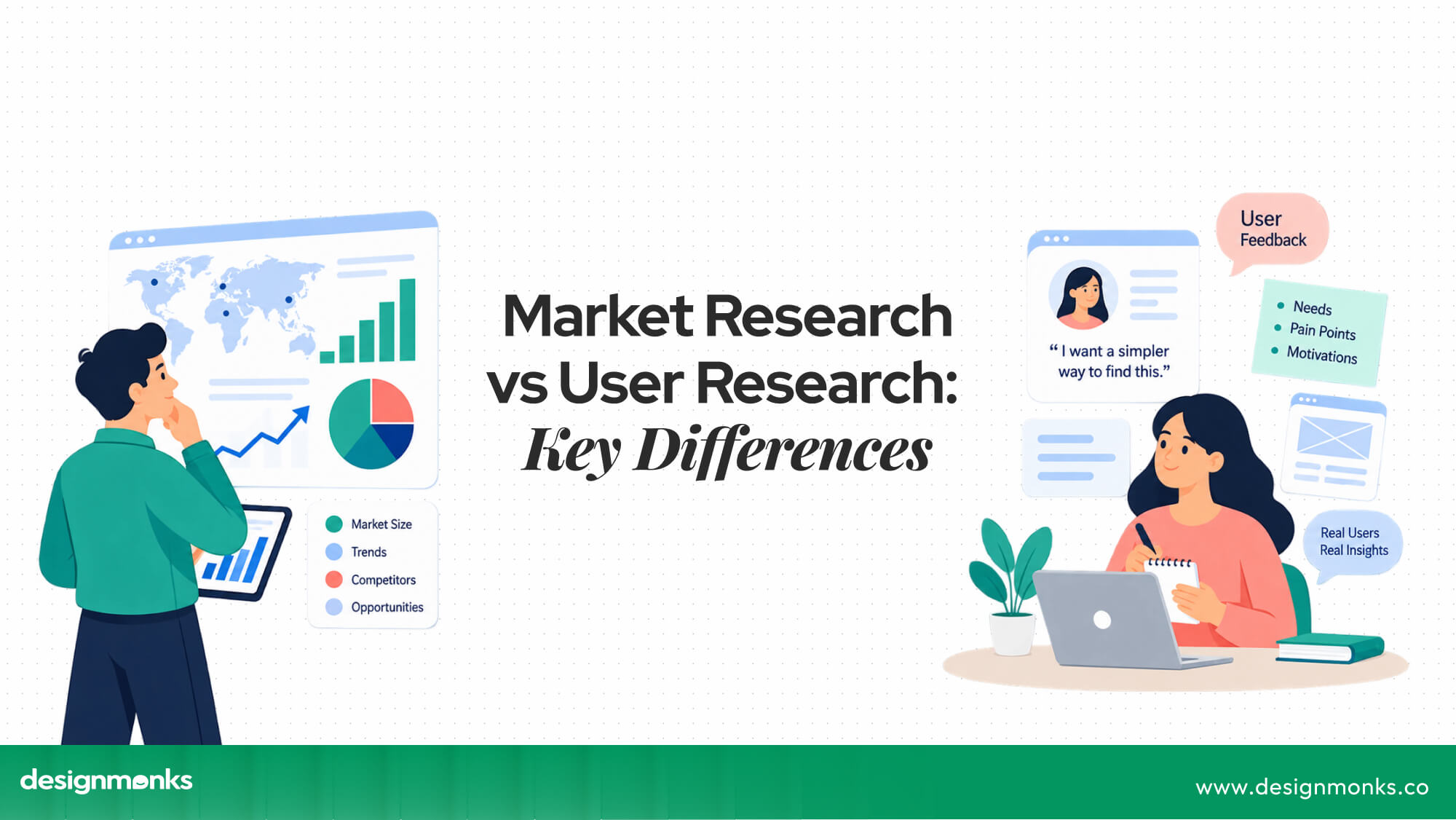
At first, market research and user research can look almost identical. Both involve asking questions, collecting data, and turning research findings into better decisions. The real difference is what you are trying to learn:
Goal
Market research focuses on understanding the market and business opportunity. It helps answer questions like whether people want a product, who the potential customers are, what competitors offer, and what customers are willing to pay.
User research focuses on understanding the people behind the product. It looks at what users need, what they are trying to accomplish, and what makes their experience difficult.
So, market research helps you understand where the opportunity is, while user research helps you understand what users need from that opportunity.
Scope
Market research has a wider scope because it looks beyond one product or user experience. It can cover an entire industry, market segment, customer group, or competitive landscape. Researchers may study market size, demand, pricing, trends, and competitor products.
User research has a more focused scope. It looks closely at specific users and their interactions with a product, service, or task. Researchers may explore user needs, behaviors, frustrations, and expectations.
In short, market research looks at the bigger market picture, while user research looks closely at the product experience.
Participants
Market research usually involves a broader target audience. Participants can include potential customers, existing customers, people who use competing products, or people from a particular customer segment. The goal is to understand preferences, buying behavior, and market demand.
User research focuses on people who use or may use the product. Researchers may recruit current users, potential users, or people who match a specific user profile.
The important difference is not simply the number of participants. It is why those people are included and what the research needs to learn from them.
Methods
Both types of research can use surveys, interviews, and focus groups, but they use these methods for different reasons.
Market research methods often include customer surveys, competitor analysis, industry reports, focus groups, pricing research, and trend analysis. These help reveal market demand and customer preferences.
User research methods often include user interviews, usability testing, observation, prototype testing, and diary studies. These help researchers understand user behavior and product experiences.
Outputs
Market research produces insights that support business and product strategy. Its findings can reveal market demand, customer segments, competitor strengths, pricing expectations, and potential opportunities.
User research produces insights that help improve the product and user experience. Its findings can reveal user needs, pain points, confusing features, behaviors, and usability problems.
So, market research often influences what opportunity to pursue, while user research helps teams decide what to improve or build for users.
When Should You Use Market Research vs User Research?
The easiest way to choose is to start with the question you need to answer.
- Do I need to understand the market? Choose Market Research.
- Do I need to understand the user? Choose User Research.
This helps you choose a research approach that actually answers the problem you are trying to solve. Let's elaborate more on that:
Choose Market Research for Market Insights
Use market research when you need to understand the market and business opportunity before or during product development. For example, for a new mobile app, you might ask:
- Is there enough market demand?
- Who are the main competitors?
- Which customer groups are underserved?
- What prices are people willing to pay?
- What trends are shaping the market?
These questions help you understand the target market and where your product could fit.
Choose User Research for User Insights
Use user research when you need to understand how people think, behave, and use a product. You might ask:
- Why do users abandon signup?
- Which part of the dashboard is confusing?
- What information do users need first?
- How do they currently solve this problem?
- What would make the experience easier?
These questions reveal user needs, behavior, and pain points that can guide product improvements.
Can Market Research and User Research Be Used Together?
Yes. Market research and user research can complement each other throughout product development. One gives the team useful context before making product decisions, while the other adds detail about the people the product is being built for.
A simple product research flow looks like this:
Market Research → Market Opportunity → User Research → User Needs → Product Design → Usability Testing
If you're planning a user research study, this 7-step process for conducting user research can help you move from defining research goals to turning findings into useful product decisions.
For example, market research might show a growing demand for a project management tool made for freelance video editors. That gives the team a clear area to explore, but there is still plenty to learn about the people in that market.
That is where user research comes in. You can talk to freelance video editors to learn how they manage projects, where they struggle, and what they expect from a better tool.
Those findings can then guide the product design. Once the product is ready, usability testing helps check whether people can actually use it easily.
Together, the two research types give product teams a stronger foundation for making decisions, from choosing an opportunity to shaping and testing the final product.
Common Mistakes to Avoid in Market and User Research
Research can give you useful answers, but only when you ask the right questions and use the findings properly. Here are some common mistakes that can weaken both market research and user research:
1. Starting Without a Clear Research Question
One of the biggest mistakes is starting research without knowing what you need to find out. Teams may run surveys, interviews, or competitor analysis simply because they feel they should.
Instead, start with the decision you need to make. Do you need to understand market demand? Find a target audience? Discover user pain points? Test a product idea? A clear research question keeps the study focused and makes the findings easier to use.
2. Asking the Wrong People
Even good research can produce poor results if you speak to people who do not represent your target audience or actual users.
For market research, your participants should match the customer group you want to understand. For user research, recruit people who actually use the product or have the problem you are trying to solve.
Getting the right participants matters more than simply getting a large number of responses.
3. Relying Only on What People Say
People do not always behave exactly as they say they will. Someone might say they would use a feature every day, but their actual behavior could tell a different story.
This is why user research can benefit from observation and usability testing, not just interviews. Market research can also combine survey responses with customer behavior, sales data, industry reports, and competitor research.
Looking at different types of evidence gives you a more complete picture.
4. Treating Research Findings as Facts
Research findings are useful, but they still need context. A small group of interviews should not automatically be treated as proof of what an entire market wants. Look for repeated patterns, compare different sources, and consider how the research was conducted before making major decisions.
5. Doing Research but Not Acting on It
Research is not useful if the findings simply sit in a presentation.
Teams should connect research findings to actual decisions. That could mean changing a product feature, testing a different target market, improving a user flow, or dropping an idea that does not have enough support.
The goal is not to collect more research. The goal is to make better decisions with what you learn.
Market Research vs User Research: An Example
Let's make this concrete with a quick SaaS example, because abstractions only get you so far.
For example, imagine a startup wants to build a tool for small accounting firms to automate client invoicing. Here's how the two research types would show up, side by side:
Market research would ask: Is there real demand for automated invoicing among small accounting firms? Who already serves this space? What's the market size, and is it growing as more firms go digital? Is there a segment that's currently underserved by the big players?
The team could answer these questions through surveys, industry reports, and competitor research.
User research, on the other hand, would ask: When an accountant actually sits down to send an invoice, what's frustrating about their current process? Do they forget to follow up on unpaid invoices? Do they hate re-entering the same client details every month? What does their ideal invoicing flow look like, step by step?
Here, you're not looking at spreadsheets of market size. You're watching three or four accountants share their screen and walk you through how they currently invoice a client.
Notice how differently these two types of research guide the startup. Market research tells the startup, “Yes, build this. There is room in the market, and here is where the gap is.”
User research tells the startup, “Here is what the product should improve, including the parts of the invoice form that cause the most friction.”
In simple terms, market research helps with the go/no-go decision, while user research helps shape the actual product. Skipping either one can create problems. You might end up with a useful product with a small market, or a promising market with a product that users find difficult to use.
FAQs
Can user research be part of market research?
Yes, user research can be part of market research, but they have different purposes. User research can provide detailed insights into specific users, while market research usually takes a broader view of the market and business opportunity.
Can you do market research and user research at the same time?
Yes, you can do market research and user research at the same time. They can be run together or at different stages of product development. Many teams use market research to understand the opportunity first and user research to understand customer needs in more detail.
What comes first, market research or user research?
There is no fixed rule, but market research often comes first when a team is still evaluating an opportunity. Once the opportunity looks promising, user research can help uncover the specific problems and needs worth solving.
Do startups need both market research and user research?
They can benefit from both, especially when building a new product. Market research can help a startup understand whether there is a real market opportunity, while user research can help it build something people actually need.
End Notes
Market research vs user research isn't about choosing one over the other. Market research shows the opportunity. User research reveals user needs. Together, they help build better products.
Even when you understand the difference, managing the research process can still feel overwhelming. Don’t worry, Design Monks’ team of research and UX experts can help you turn market and user insights into confident product decisions and experiences that deliver results.


.avif)
.avif)
.avif)
.avif)


.avif)
.avif)
.avif)
.avif)






.avif)