
Key Takeaways
- Vibe coding speeds development but can introduce hidden security and reliability risks.
- AI-generated code needs human review, testing, and proper security checks.
- Poor architecture and duplicated code increase technical debt and maintenance costs.
- Sensitive applications require stronger security, privacy, and engineering oversight.
- Regular audits, verified dependencies, and automated testing reduce production risks.
Nothing feels easier than describing an idea in plain English and watching AI turn it into a working application. But here's the catch, code that runs isn't necessarily code that's safe, reliable, or ready for real users.
That's why understanding vibe coding risk factors matters as much as learning to write better prompts. AI-generated software may include security gaps, incorrect assumptions, fragile logic, or dependencies that create trouble later. These problems often remain hidden until the application faces real-world conditions.
So, what can go wrong with vibe coding, and how can you prevent those mistakes before they become costly? Let's explore the biggest risks developers should watch for and the practical ways to keep AI-generated code reliable, secure, and ready for real users.
What Are the Risk Factors of Vibe Coding?
Vibe coding involves building software by describing your requirements in natural language and letting AI generate the code. You guide the process through prompts, test the output, and request changes without necessarily reviewing every line.
This makes development faster, especially when building prototypes or testing new ideas. However, this approach creates several risks.
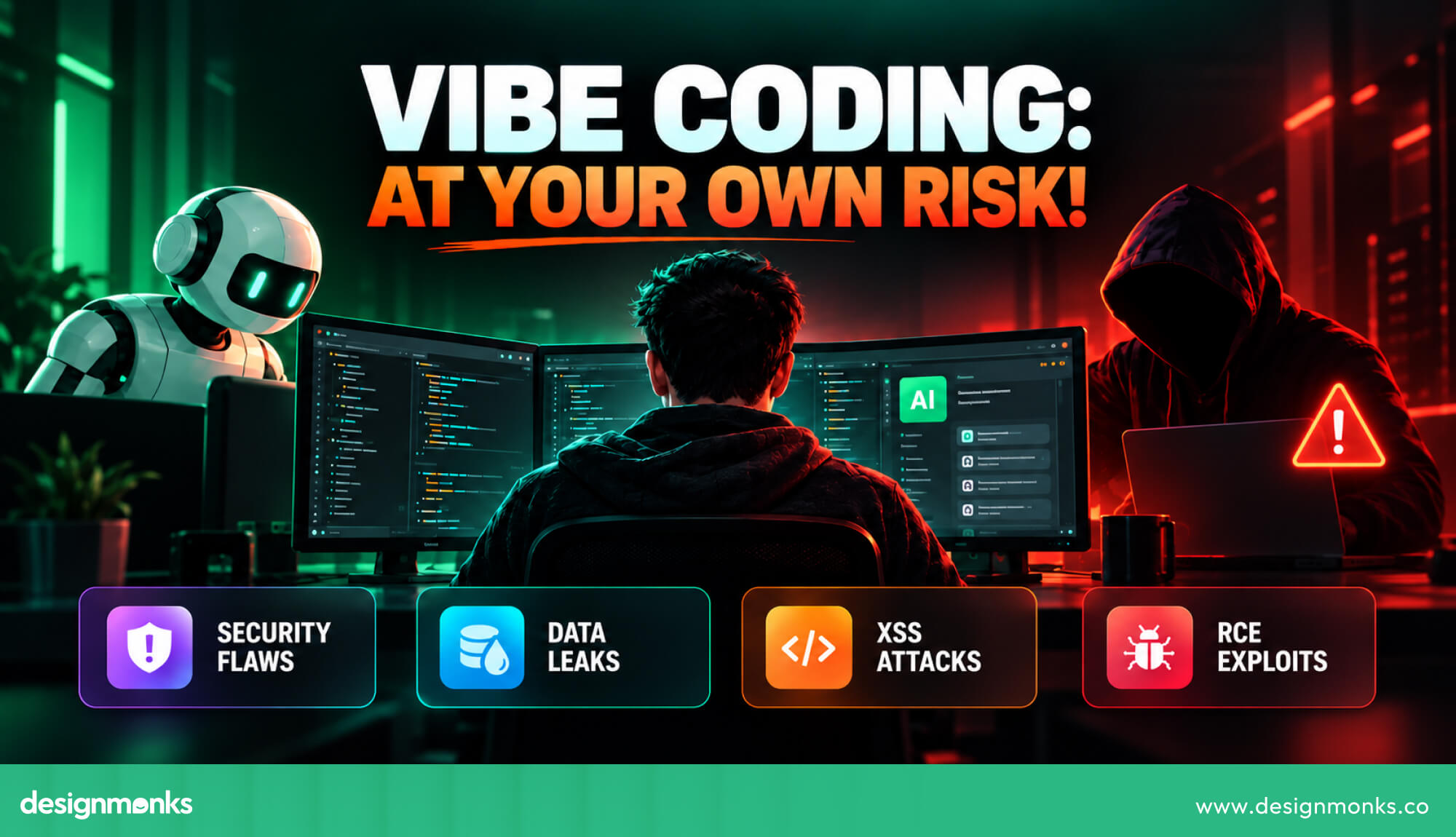
Here are the major risk factors to understand before using vibe coding:
- Security vulnerabilities: AI may generate code with weak authentication, exposed API keys, or other security flaws.
- Incorrect or hallucinated code: AI can produce inaccurate logic, outdated solutions, or code that doesn't match the actual requirements.
- Hidden bugs: Some errors only appear under specific conditions, making them difficult to catch through basic testing.
- Poor code architecture: AI-generated code may lack a clear structure, making the application harder to expand or update.
- Unsafe dependencies: AI may suggest outdated, vulnerable, or unnecessary third-party libraries.
- Data privacy leaks: Sensitive user information, credentials, or business data may be exposed through poorly handled code or AI tools.
- Technical debt: Quick fixes and poorly written code can create more work and higher maintenance costs later.
- Lack of code ownership: Developers may struggle to understand, explain, debug, or maintain code they didn't properly review.
These risks can affect everything from application security to development costs and user trust. Let's explore each one in detail and understand what can go wrong when you rely on AI to build software.
Why Vibe Coding Creates Different Types of Software Risk
Vibe coding creates different software risks because AI can generate code faster than developers can understand, review, and test it. A feature may look complete while its code contains security weaknesses, incorrect logic, or unnecessary dependencies. Three factors make these risks particularly important:
Speed Can Outpace Verification
AI can generate hundreds of lines of code within minutes, but reviewing and testing that code takes longer. When developers prioritize speed, they may skip code reviews or overlook hidden errors. This allows problems to enter applications before anyone notices them.
AI Focuses on Instructions, Not Security
AI follows the instructions developers provide but does not automatically consider every security requirement. For example, asking it to build a login system does not explain how to protect passwords, manage sessions, or prevent unauthorized access.
Without clear requirements, AI may generate working but insecure code.
Developers May Not Understand the Generated Code
Developers may accept AI-generated functions without understanding how they work or connect. This makes debugging, reviewing, and updating the application harder. When problems appear, they may depend on AI for fixes, sometimes introducing further errors and increasing maintenance costs.
The Major Vibe Coding Risk Factors
Vibe coding can introduce problems in several areas of software development. Some affect how securely an application handles information, while others make the code harder to maintain or expand.
Understanding these risks helps developers identify problems before they affect real users:
Security Vulnerabilities
AI-generated applications can contain security weaknesses that attackers may exploit. Common examples include SQL injection, cross-site scripting (XSS), and broken access control.
Hardcoded API keys, exposed secrets, insecure authentication, and insufficient input validation can also put applications at risk. Developers should review these areas against established security guidance from OWASP.
Hallucinated or Incorrect Code
AI can generate code that looks correct but contains false assumptions, nonexistent API methods, or incorrect logic. A feature may appear to work while producing inaccurate results in certain situations.
These errors can remain hidden until users encounter them.
Technical Debt and Poor Code Quality
AI-generated code may contain duplicated functions, inconsistent patterns, and unnecessary logic. Over time, this creates spaghetti code and increases the maintenance burden.
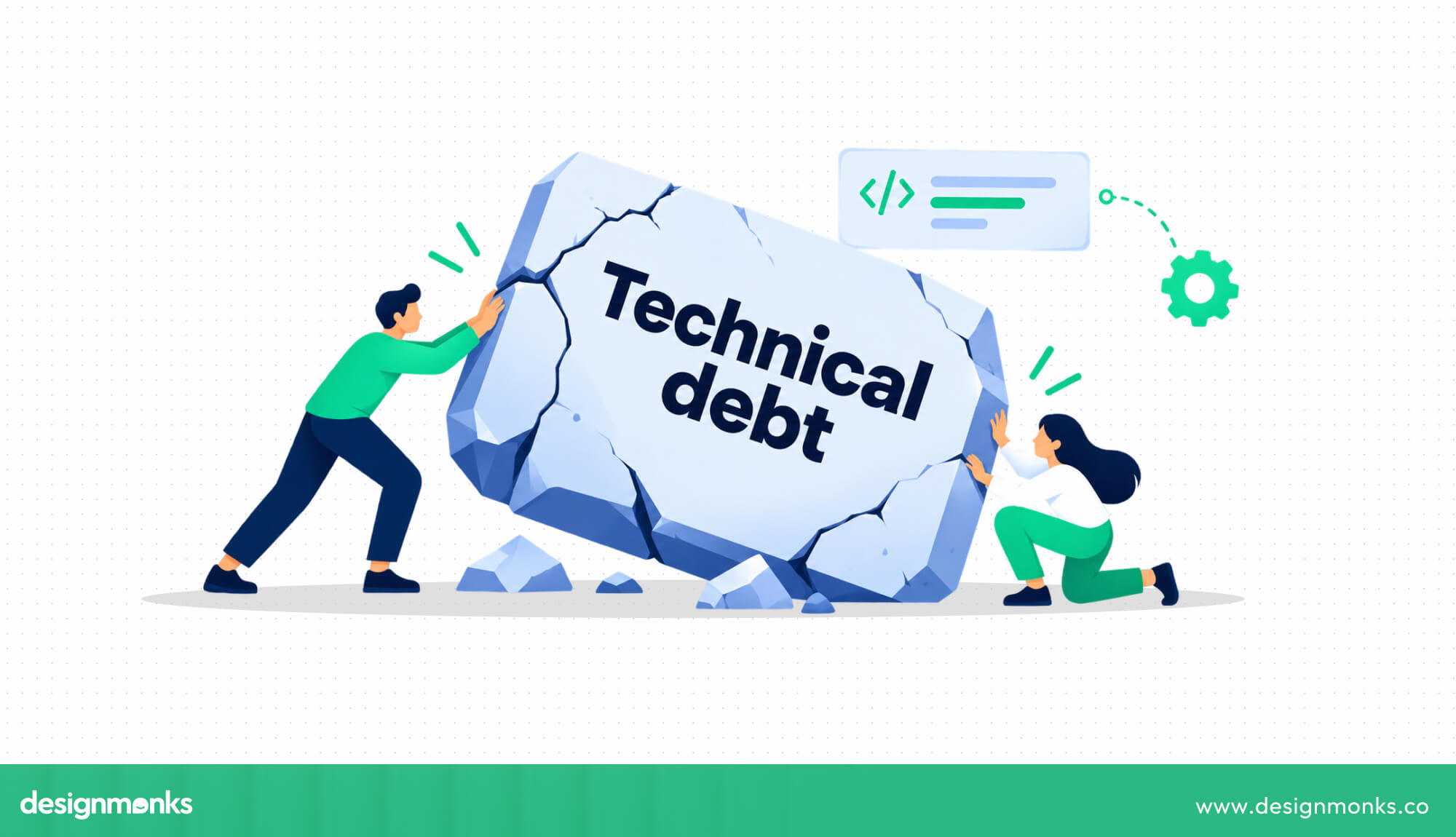
These problems may not affect a small prototype immediately. However, they become more expensive when the application needs new features, performance improvements, or security updates.
Developers eventually need to refactor the code. AI can help with refactoring, but developers still need to review the changes. Otherwise, one quick fix may introduce another problem.
Dependency and Supply-Chain Risks
AI tools sometimes suggest software packages that are outdated, unsafe, or do not even exist. Developers may also install packages with names similar to trusted ones without noticing the difference.
This creates a supply-chain risk because a harmful package can introduce security problems into an otherwise safe application.
For example, a fake package could contain code that steals user information or gives attackers access to an application. Before installing any dependency, check its name, publisher, version, update history, and known security issues.
Tools such as npm and PyPI can help developers find package information and verify what they are using.
Weak Architecture and Scalability Problems
An AI-generated application may work well as a small prototype but struggle when more features, users, or integrations are added. This often happens because the original software architecture was not planned for future growth.
Poorly connected components, repeated code, and unclear structures can make changes harder. These problems are known as architectural drift and tight coupling.
They also increase system complexity and limit scalability. For example, a booking app may work with a few users but slow down when hundreds of people try to book at once. A well-planned architecture helps maintain performance as the application grows.
Bugs, Edge Cases and Silent Failures
An app can run without errors and still behave incorrectly. AI-generated code may miss unusual situations, known as edge cases. For example, a registration form might fail when users leave fields empty or enter invalid details.
Other problems include lost data, wrong calculations, and unexpected user actions. Some errors happen without clear warnings. Proper software testing helps catch them before launch.
Developers should test different inputs, common tasks, and unusual situations. Clear error messages and input checks also help prevent failures.
Privacy and Sensitive Data Exposure
Vibe-coded apps can expose private information if data is not handled safely. This may include customer details, financial records, health information, or login credentials.
Problems can happen when developers share sensitive data in AI prompts or when an app stores information without proper protection. For example, a weak database setup could let outsiders view customer records.
To prevent data leaks, businesses should protect sensitive information and control who can access it. They must also follow data privacy rules, such as GDPR.
Authentication and Access-Control Failures
An app must check who users are and what they can access. Authentication confirms a user's identity, while authorization controls their permissions.
AI-generated code may allow users to access information that does not belong to them. For example, a customer might change a URL and view someone else's order. This is called IDOR. Weak role-based access control and poor session management can create similar risks.
Developers should test every user role and prevent privilege escalation.
Maintainability and Lack of Code Understanding
AI can write code quickly, but developers still need to understand it. Accepting generated code without review can make future updates difficult.
For example, a developer may struggle to fix an inventory app if its code is poorly organized or lacks documentation. This increases technical debt and maintenance costs. It can also make it harder for new team members to understand the project. Code reviews, clear documentation, and consistent coding practices help improve maintainability.
Deployment and Operational Risks
An app may work during development but fail after launch. This can happen because of incorrect settings, missing security controls, or poor deployment practices. Common risks include misconfigured environment variables, exposed credentials, and insecure cloud configuration.
Without monitoring, teams may not notice errors or unusual activity. A poor rollback strategy can also make failed updates harder to fix. Before launch, check deployment settings, protect passwords and API keys, and prepare backups.
Also review shadow deployments, where apps go live without proper approval.
Business and Production Impact of Vibe Coding Risks
The technical problems associated with vibe coding can eventually affect an organization's finances, customers, and daily operations.
A prototype with a few bugs may not create serious consequences. However, the same problems become more expensive when an application handles customer information, payments, or business-critical tasks. Here are some ways vibe coding risks can affect businesses:
Higher Maintenance Costs
Vibe coding can reduce initial development time, but poorly structured applications may cost more to maintain later.
Duplicated code, inconsistent architecture, and unexplained functions make debugging and updates more difficult. Developers need to spend additional time understanding the existing system before they can make even small changes.
Businesses may also need to hire experienced developers to review or rewrite parts of an application built without proper technical planning. The original development may have been inexpensive, but the total cost of ownership can increase as maintenance requirements grow.
Security Incidents and Data Loss
A security weakness in a production application can lead to unauthorized access, data exposure, or service disruption. For example, broken access control may allow users to view private customer records. Exposed API credentials may give attackers access to connected services. Poor database security may also put important business information at risk.
The consequences can include financial losses, customer complaints, recovery expenses, and damage to business reputation.
Compliance and Legal Exposure
Businesses that handle personal, financial, or health information must follow applicable data protection and industry requirements. An AI-generated application that stores sensitive information without proper controls can create compliance problems.
For example, a healthcare application may need strict access restrictions and appropriate protection for patient information. A financial platform may require additional controls for transactions and account data.
Regulations such as GDPR may also apply depending on the organization, its users, and the information it processes. Using AI to build the application does not transfer legal responsibility to the AI provider.
The organization operating the application remains responsible for meeting its applicable obligations.
Vendor and Developer Dependency
Relying too heavily on one AI platform or a single developer can create long-term business risks.
For example, a company depends on a particular AI tool for generating, updating, and debugging its application. Now, if there are changes to that tool's pricing, availability, or capabilities, it will affect its development process.
Similarly, if only one person understands how the generated application works, the business may struggle when that person leaves.
Organizations should maintain documentation, source-code access, development standards, and clear technical ownership. This makes it easier for other developers to maintain the application when requirements change.
When Does Vibe Coding Become High Risk?
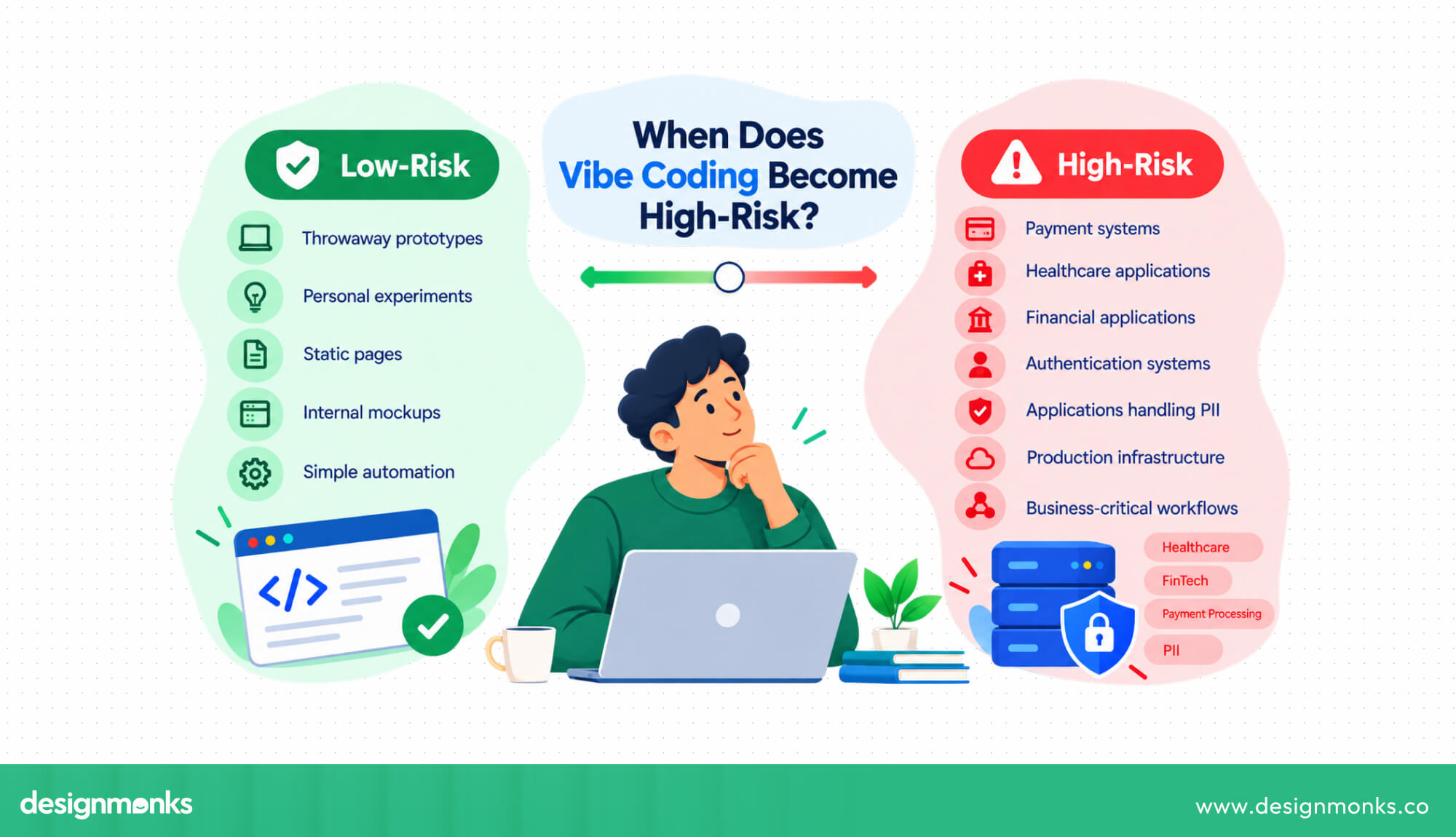
Vibe coding is not equally risky for every project. The level of risk depends on what the application does, what information it handles, and how it will be used.
A simple prototype has different security requirements from a payment platform or healthcare application. The important distinction is whether an application will handle real users, sensitive information, or critical business operations.
Low-Risk Use Cases
Vibe coding is generally more suitable for projects where mistakes have limited consequences, and the application does not handle sensitive information. These cases have lower risks:
- Throwaway prototypes: Early versions built to test an idea or demonstrate a feature.
- Personal experiments: Small applications created for learning or individual use.
- Static pages: Simple websites that display information without complex data processing.
- Internal mockups: Visual demonstrations used to collect feedback before development begins.
- Simple automation: Small scripts that perform repetitive tasks without accessing critical systems.
These projects still benefit from code review and basic testing. However, their potential impact is usually more limited.
High-Risk Use Cases
Vibe coding requires much stronger technical oversight when applications handle sensitive data, financial transactions, or important business operations. These applications can create higher risks:
- Payment systems: Applications that process payments, manage transactions, or store financial information.
- Healthcare applications: Platforms that manage patient records, medical information, or healthcare workflows.
- Financial applications: Banking, lending, investment, and accounting systems.
- Authentication systems: Applications responsible for verifying user identities and controlling access.
- Applications handling PII: Platforms that collect personal identification details or other sensitive user information.
- Production infrastructure: Systems responsible for hosting, managing, or securing important services.
- Business-critical workflows: Applications that support essential operations where failure could interrupt business activities.
These applications need experienced engineering oversight, security testing, and proper quality assurance before production use.
The main point is that vibe coding becomes more concerning as the consequences of failure increase. Using AI to create a prototype is very different from allowing unreviewed AI-generated code to control real payments or sensitive customer information.
How to Assess the Risk of an Existing Vibe-Coded App
An existing vibe-coded application does not automatically need to be rebuilt. However, developers should examine its code, security, testing, and production setup before allowing real users to depend on it. A practical assessment should cover four areas:
Code and Architecture Review
Check for duplicated functions, inconsistent coding patterns, unexplained logic, and unnecessary dependencies. Review how different components communicate and whether the architecture can support future changes.
Security Review
Examine authentication, authorization, API endpoints, database queries, and input validation. Check for hardcoded credentials, exposed secrets, and vulnerable dependencies. Security testing tools can help identify weaknesses that manual reviews might miss.
Testing Review
Review whether the application has unit, integration, and end-to-end tests. Test important workflows, invalid inputs, and unusual user actions. Pay particular attention to silent failures and incorrect outputs.
Production Readiness Review
Check environment variables, cloud permissions, backups, logging, and monitoring. Confirm that developers can restore an earlier version if an update fails. Documentation should also explain how to configure, deploy, and maintain the application.
Tools such as SAST(Static Application Security Testing) and DAST(Dynamic Application Security Testing) can support the assessment by checking source code and running applications for potential vulnerabilities. The goal is to identify weaknesses before they become production problems.
If your vibe-coded app has usability issues, inconsistent UI, or a codebase that's difficult to maintain, a vibe-coded app redesign can help turn the existing product into a more polished, usable, and maintainable application. A proper redesign can address UI/UX problems, improve user flows, and help prepare the app for real users.
When Should You Hire an Agency to Assess the App?
If your team lacks the expertise to assess a vibe-coded application, hiring an experienced agency can help. An expert agency like Design Monks can support the entire process, from reviewing code and architecture to identifying security vulnerabilities, testing functionality, and evaluating production readiness.
The team can also improve the app's UI/UX, refine user flows, and implement necessary changes to make the product more secure, reliable, usable, and easier to maintain.
How to Reduce Vibe Coding Risks
Developers can reduce vibe coding risks by combining AI assistance with established software development practices. AI can speed up implementation, but code review, testing, and security checks should remain part of the process. Here are a few things you can do to reduce vibe coding risks:
Keep a Human in the Review Loop
Treat AI-generated code as a draft that needs verification. Developers should understand important functions, check their logic, and review security-sensitive features before accepting them.
This is especially important for authentication, database operations, and payment processing.
Use Automated Security and Code Testing
Automated tools help identify problems that may be difficult to notice manually. SAST(Static Application Security Testing) checks source code, while DAST(Dynamic Application Security Testing) examines running applications.
Dependency scanning, secret scanning, and unit testing provide additional protection. Integration and end-to-end tests can also help verify complete application workflows. These checks can also run through CI/CD pipelines whenever developers submit changes.
Verify Dependencies Before Installing Them
Check package names, publishers, versions, maintenance activity, and known vulnerabilities before installing external libraries. Avoid unnecessary dependencies and use trusted repositories such as npm and PyPI. This reduces the chance of introducing outdated or malicious packages.
Define Security Requirements in the Prompt
Give AI clear instructions about authentication, authorization, input validation, session management, and data protection. Specific requirements help the tool generate more relevant code.
However, detailed prompts do not replace security reviews or testing.
Keep AI-Generated Changes Small and Reviewable
Divide large development tasks into smaller changes. Build and test one feature before moving to another. Smaller updates make it easier to identify errors, review code, and understand what has changed.
They also reduce the difficulty of debugging when something breaks.
Vibe Coding Risk Checklist Before Production
Before deploying a vibe-coded application, check whether the essential security, testing, and maintenance requirements have been covered:
- Authentication has been reviewed and tested.
- Authorization and user permissions have been verified.
- Hardcoded secrets and exposed credentials have been removed.
- External dependencies have been verified.
- Input validation has been tested.
- API endpoints have been reviewed.
- Sensitive data has been identified and mapped.
- Automated security scanning has been completed.
- Edge cases and unusual user actions have been tested.
- Logging and monitoring have been configured.
- A backup and rollback strategy is available.
- A human engineer understands and owns the codebase.
- Technical documentation is available.
Passing this checklist does not guarantee complete security. However, it helps developers catch common problems before users depend on the application. For further assurance, you can contact agencies like Design Monks to audit your application, identify security gaps, and improve its overall reliability.
FAQs
What Is the Biggest Risk of Vibe Coding?
Security vulnerabilities are among the biggest vibe coding risks. AI-generated code may contain insecure authentication, broken access control, or exposed credentials that put user information at risk.
Is Vibe Coding Safe for Production?
Yes, vibe coding is safe for production. But AI-generated code needs proper human review, security testing, and quality checks before deployment. Sensitive and business-critical applications require experienced engineering oversight.
Can AI-Generated Code Contain Security Vulnerabilities?
Yes. AI-generated code can contain SQL injection, cross-site scripting, insecure authentication, and other security vulnerabilities. Developers must review and test the code before using it in production.
Does Vibe Coding Create Technical Debt?
Yes, vibe coding can create technical debt when developers prioritize getting an application working over building it properly. AI-generated code contains duplicated functions, unnecessary dependencies, inconsistent coding patterns, or quick fixes. Over time, these issues make applications harder to maintain, debug, and update.
Can AI Hallucinate Programming Packages?
Yes, AI can hallucinate programming packages. AI can recommend nonexistent packages or incorrect dependency names. Attackers may exploit this through slopsquatting by registering malicious packages using names AI tools might generate.
Is Vibe Coding Safe for Apps Handling Sensitive Data?
It requires extra caution. Developers must verify access controls, encryption, data storage, and privacy requirements before allowing applications to handle personal, financial, or health information.
How Do You Test a Vibe-Coded Application?
Use code reviews, unit tests, integration tests, end-to-end tests, and security assessments. Also test invalid inputs, unusual user actions, API behavior, and error handling.
How Can Developers Reduce Vibe Coding Risks?
Developers can reduce risks through human code reviews, verified dependencies, automated security scanning, and regular testing. Keeping changes small also makes AI-generated code easier to understand and maintain.